
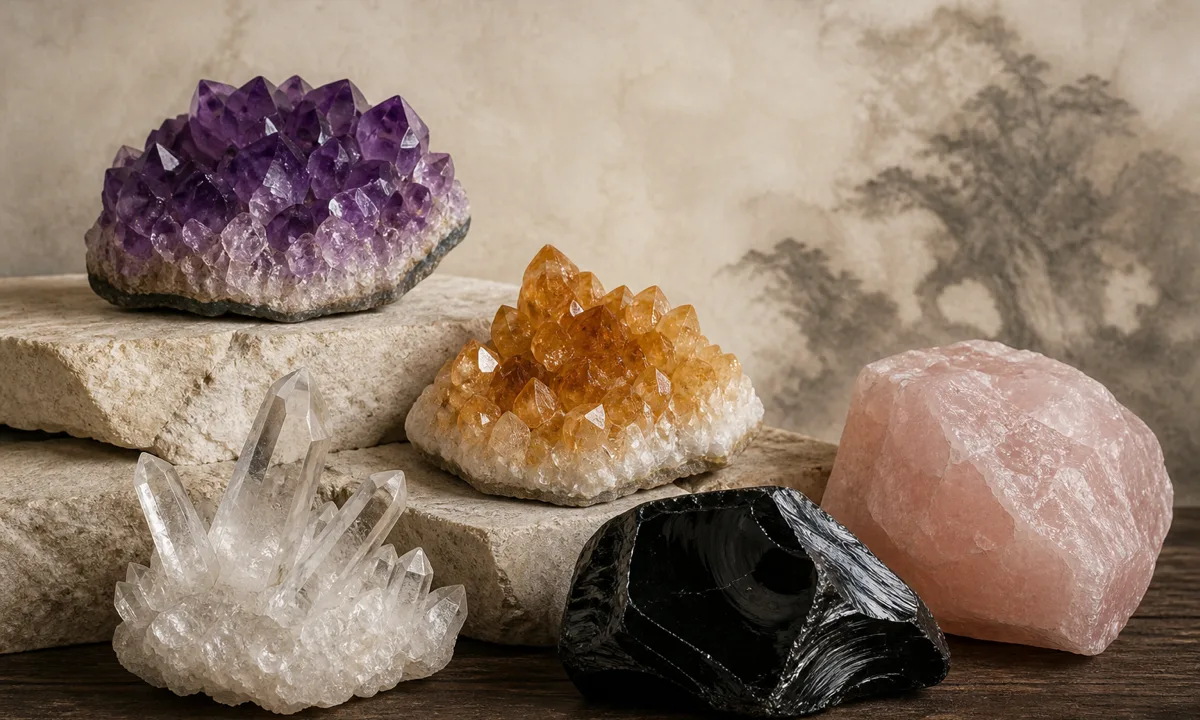
Protection crystals are among the most requested stones in crystal culture — dark, grounding stones like black tourmaline, obsidian, and smoky quartz that people have carried and placed in homes for centuries. The idea behind them is simple and deeply human: certain colors and stones have long been associated with creating a calm, guarded, grounded atmosphere.
This guide covers protection crystals in depth: what "protection" means in crystal traditions, the most popular protective stones and their meanings, how to use them in your home, and how they fit into feng shui practice.
What does "protection" mean in crystal traditions?
In crystal and feng shui traditions, "protection" does not mean physical shielding in a scientific sense. It refers to a set of cultural associations built up over centuries — the idea that certain dark, dense, grounding stones help create a stable, calm atmosphere, and that carrying or placing them can support a feeling of being anchored and at ease.
The traditional logic is consistent across cultures: dark colors are associated with the earth, with depth, and with stillness, so dark stones are the natural candidates for grounding and steadying energy. Just as a heavy stone anchors a boat in a harbor, these stones are thought of as anchoring presences in a room or on a person. These are cultural and spiritual beliefs — useful as tools of intention, not as substitutes for physical security or professional care.
Popular protection crystals and their meanings
Here are the most commonly used protection crystals and what each one traditionally means:
| Crystal | Color | Traditional meaning | Typical use |
|---|---|---|---|
| Black tourmaline | Black | Grounding, shielding, balance | Entryway, near electronics, worn |
| Obsidian | Black | Shielding, reflection, grounding | Entryway, windowsill, meditation |
| Smoky quartz | Brown-gray | Grounding, stability, calm | Workspace, living room, worn |
| Black onyx | Black | Strength, discipline, focus | Worn, desk |
| Hematite | Silver-gray | Grounding, focus, stability | Worn, desk, pocket |
| Jade | Green | Harmony, longevity, protection | Worn, displayed in home |
| Amethyst | Purple | Calm, clarity, spiritual focus | Bedroom, meditation space |
| Tiger's eye | Gold-brown | Courage, confidence, protection | Desk, wallet, worn |
Two practical notes on this list. First, the "protection" association is strongest with dark, dense stones — black tourmaline, obsidian, smoky quartz, black onyx, and hematite are the classic choices. Second, a few non-black stones carry protective meanings too: jade has long been considered a protective stone in Chinese culture, and tiger's eye has been carried as a talisman for courage in many traditions.
How to use protection crystals at home
Protection crystals are traditionally placed where you want a steady, grounded atmosphere. There is no single right way — the practice is about placement and intention — but these are the most common uses:
| Placement | Intended purpose | Practical tip |
|---|---|---|
| Entryway | A calm, grounded first impression | A piece of black tourmaline or obsidian by the door |
| Near electronics | Steadying the "busy" feel of screens | A small stone on or beside the router, TV, or desk |
| Bedroom | A restful, anchored atmosphere | Black tourmaline or smoky quartz on a nightstand |
| Worn as jewelry | A personal sense of grounding | A black onyx or hematite bracelet |
| Carried in a pocket | A quiet daily companion | A small tumbled stone you can hold |
| Meditation space | Supporting stillness and focus | Obsidian or black tourmaline near your cushion |
The meaningful part is your intention: the stone is a reminder and a focus for the calm, grounded atmosphere you want to create. It is not a replacement for locks, smoke detectors, or professional advice — it is a cultural tradition for atmosphere and self-reflection.
Protection crystals in feng shui
In feng shui, protection crystals fit into the broader practice of placing objects to shape the energy of a space. Dark, grounding stones are considered "yin" in quality — quiet, receptive, and steadying — which makes them suitable for restful spaces and entryways:
- Entryways are the classic spot for grounding stones like black tourmaline and obsidian — a traditional place to "receive" calm energy as you come home.
- Bedrooms suit smoky quartz and black tourmaline, which are considered calming and steadying rather than stimulating.
- Workspaces can benefit from hematite or black onyx, traditionally associated with focus and discipline.
- Near electronics is a common modern placement — many people keep black tourmaline beside routers and monitors simply because it is a grounding stone, and it reminds them to take breaks.
As with all feng shui practices, the meaningful part is your intention: the stone is a reminder and a focus for the atmosphere you want to create, arranged with care in the places you spend your time.
How to choose and care for protection crystals
The same selection criteria apply as for any crystal — but a few specifics matter for the classic protective stones:
- Color depth. For black stones, look for deep, even color. Faded or grayish black tourmaline is lower quality; rich, uniform black is better.
- Weight and density. Dense stones like hematite feel notably heavier than they look. That weight is natural — hematite is an iron oxide — and it is one way to identify the real stone.
- Cleansing. Traditional care is simple: rinse gently in cool water, place in moonlight overnight, or use incense smoke. These practices of intention also keep the stones clean.
- Hardness. Most protective stones are hard and durable (tourmaline 7, smoky quartz 7, onyx 6.5-7), while hematite is softer (5.5-6.5) and can scratch — store it separately.
- Seller honesty. Buy from a seller who states the stone's origin and shows clear photos. Hematite in particular has cheap imitations.
Bringing protection crystals into daily life
Protection crystals are practical stones — easy to wear, easy to place, easy to live with. A black tourmaline by the door, a hematite bracelet on the wrist, a smoky quartz on the desk: each is a small, steady presence that carries centuries of cultural meaning about grounding and calm.
Whether you are drawn to them for their color, their history, or their feng shui associations, protective stones are among the most approachable in the crystal family. Like all crystal practices, their use is a cultural and spiritual tradition for self-reflection and atmosphere — if you have health concerns, always consult a qualified professional rather than relying on stones or beliefs alone.
---
Related reading
- Crystals and their meanings — the full guide to popular stones
- Crystals for focus — grounding and clarity for the workspace
- Citrine bracelet meaning — the warm, optimistic side of the crystal family
- Feng shui home office layout — a grounded space to work in
- Feng Shui explained — the principles behind every placement
Frequently Asked Questions
What are the best protection crystals?
The classic protection crystals are dark, grounding stones: black tourmaline, obsidian, smoky quartz, black onyx, and hematite. Jade and tiger's eye also carry protective associations in their respective traditions. "Protection" here means cultural and spiritual grounding associations, not physical shielding.
How do I use a protection crystal?
Place it where you want a steady, calm atmosphere — by the entryway, in the bedroom, near electronics, or at your desk — or carry it as a small tumbled stone or bracelet. The practice is about placement and intention: the stone is a reminder and a focus for the grounded atmosphere you want to create.
Is black tourmaline a protection stone?
Yes. Black tourmaline is the most commonly cited protection crystal — a black, dense stone traditionally associated with grounding, shielding, and balance. It is commonly placed by entryways and near electronics, and it is sturdy enough (7 on the Mohs scale) for everyday jewelry.
Can protection crystals help with anxiety?
Protection crystals carry traditional cultural associations with calm and grounding, and for some people holding or seeing a meaningful stone is a comfort. These are cultural and spiritual practices, not medical treatments — if anxiety affects your daily life, consult a qualified professional.
Where should I place protection crystals in my home?
Common placements are the entryway (black tourmaline or obsidian), the bedroom (smoky quartz or black tourmaline), near electronics, and at your desk (hematite or black onyx). Place them where you want a steady, grounded atmosphere — the meaningful part is your intention.