Crystals have been part of human culture for thousands of years — worn as jewelry, placed in homes, carried as talismans, and used in spiritual and healing traditions across the world. Each stone has gathered its own set of meanings over the centuries: cultural and spiritual associations passed down through generations, connecting color, history, and intention.
This complete guide covers crystals and their meanings in depth: the most popular stones and what they symbolize, how to choose a crystal for yourself, how to care for your collection, and how crystals are traditionally used in feng shui.
What does "crystal meaning" mean?
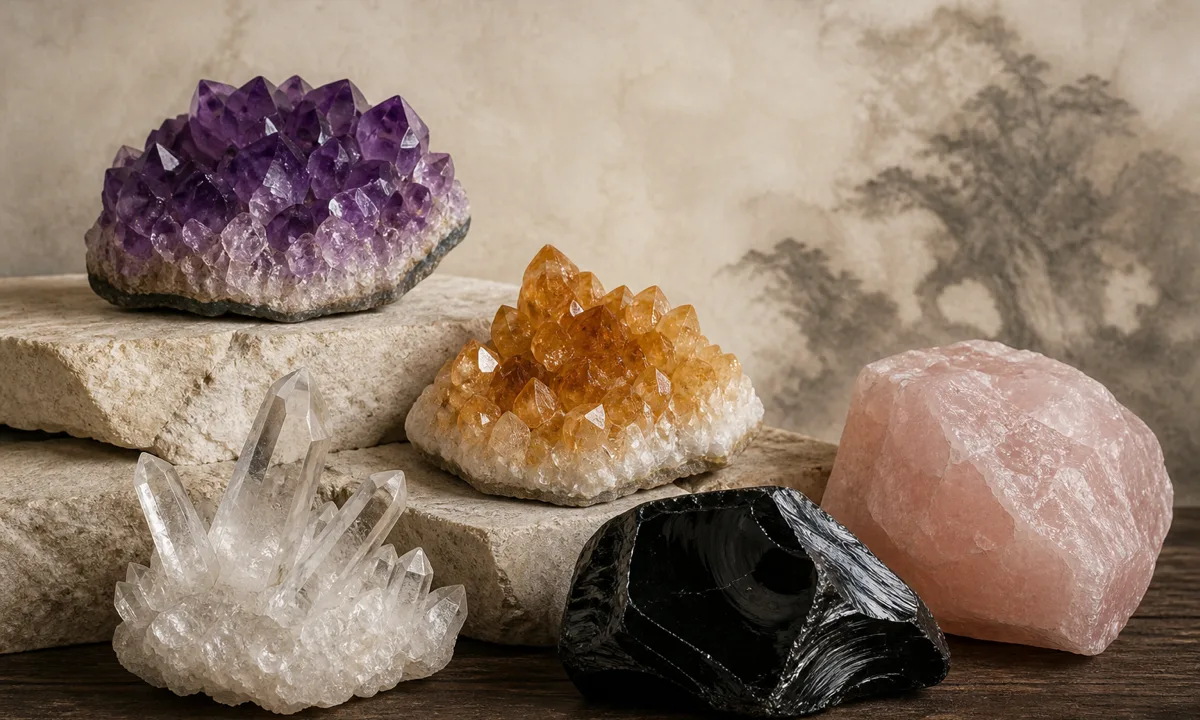
When people talk about crystal meanings, they are referring to the traditional associations a stone carries — the symbolism built up over centuries of use in jewelry, art, religion, and folk practice. A crystal's meaning is usually inspired by its color, its place of origin, or a historical story attached to it. Rose quartz is pink, so it became the stone of love; amethyst is purple, the color long linked to royalty and calm; citrine is golden, so it carries associations of sunlight and abundance.
These meanings are cultural traditions, not scientific properties. Crystals do not replace medical care, financial planning, or good judgment. What they offer — across cultures and across thousands of years — is a language of intention: a way to mark what you want to invite into your life and a reminder to pay attention to it.
Popular crystals and their meanings
Here is a practical guide to the most popular crystals and their traditional meanings:
| Crystal | Color | Traditional meaning | Common use |
|---|---|---|---|
| Clear quartz | Clear / white | Clarity, amplification, focus | Desk, meditation, anywhere |
| Amethyst | Purple | Calm, clarity, wisdom | Bedroom, meditation corner |
| Rose quartz | Pink | Love, compassion, softness | Bedroom, relationship corner |
| Citrine | Golden | Optimism, abundance, warmth | Desk, southeast corner, wallet |
| Black tourmaline | Black | Grounding, protection, balance | Entryway, near electronics |
| Obsidian | Black | Shielding, reflection, grounding | Entryway, windowsill |
| Smoky quartz | Brown-gray | Grounding, stability, calm | Workspace, living room |
| Jade | Green | Harmony, longevity, protection | Worn, displayed in home |
| Lapis lazuli | Deep blue | Wisdom, communication, truth | Desk, study |
| Carnelian | Orange-red | Courage, vitality, creativity | Workspace, creative corner |
| Tiger's eye | Gold-brown | Confidence, courage, focus | Desk, wallet |
| Selenite | White / clear | Clarity, cleansing, stillness | Meditation space, altar |
| Fluorite | Multicolor | Focus, order, mental clarity | Study, desk |
Two things to notice in this chart. First, the same stone can carry multiple meanings, and different traditions may emphasize different ones — jade, for example, is a symbol of honor in China, a stone of longevity in other traditions, and a good-luck gift almost everywhere. Second, meaning often follows color: warm stones (citrine, carnelian, tiger's eye) tend to carry active, energizing associations, while cool stones (amethyst, lapis lazuli, smoky quartz) tend to carry calm, reflective ones.
How to choose a crystal for yourself
There is no wrong way to choose a crystal, but a few approaches make the choice more meaningful:
- Choose by meaning. Decide what you want to invite into your life — calm, focus, courage, warmth — and pick the stone associated with it. This is the most common approach, and it gives the stone a clear role.
- Choose by color. If you are drawn to a color, the stone that carries it will naturally feel meaningful to you. Color-based choices are simple and intuitive.
- Choose by feeling. Many people pick the stone they are simply drawn to — the one that catches their eye or feels right in the hand. In the tradition, this instinct is considered a perfectly good guide.
- Choose by use. Think about where the stone will live — a desk, a bedside table, a piece of jewelry — and choose a stone and size that fit that space.
When buying, look for honest sellers who describe the stone's origin and treatment, and show clear photos. Natural stones have variation; that is part of their character, not a flaw.
How to care for and cleanse your crystals
Traditional care for crystals is simple, and following it keeps your collection looking its best:
- Cleansing. Many people cleanse crystals by rinsing them gently in cool running water, placing them in moonlight overnight, or using incense smoke. These are traditional practices of intention, and they also keep the stones physically clean.
- Charging. Placing a stone in indirect moonlight or a calm, quiet spot is a common way people "reset" a crystal's energy.
- Sunlight caution. Prolonged direct sunlight can fade some stones (amethyst, rose quartz, and others), so store and display them away from strong, constant sun.
- Hardness matters. Soft stones (selenite, for example, at 2 on the Mohs scale) scratch easily and should be kept separate from harder ones. Store crystals in a lined box or individual pouches.
- Everyday care. Wipe with a soft cloth; avoid harsh chemicals and ultrasonic cleaners for fragile stones.
Crystals in feng shui
In feng shui, crystals are used as tools of color, placement, and intention. The practice is about arranging your environment to support the atmosphere you want, and crystals are one traditional way to do that:
| Feng shui area | Typical crystals | Intended purpose |
|---|---|---|
| Entryway | Black tourmaline, obsidian | Grounding, a calm welcome |
| Living room | Clear quartz, jade | Harmony, clear atmosphere |
| Bedroom | Amethyst, rose quartz | Rest, calm, warmth |
| Desk / study | Citrine, tiger's eye, fluorite | Focus, motivation, clarity |
| Southeast corner | Citrine | Traditional abundance associations |
| Meditation space | Selenite, clear quartz | Stillness, clarity |
The feng shui perspective on crystals is the same as the general one: the stone is a reminder and a focus for your intention, not a mechanical device. Place crystals where you want their associated quality to be present, and let them serve as a gentle daily reminder of the atmosphere you are building.
Where to start with your crystal collection
If you are new to crystals, a small, thoughtful collection is better than a large random one. Start with two or three stones that match the qualities you want to work with — for example, amethyst for calm, citrine for optimism, and black tourmaline for grounding. Learn to care for them, notice how it feels to have them in your space, and add to the collection slowly.
Whatever you choose, approach crystals with the mindset the tradition itself recommends: cultural and spiritual tools for self-reflection and atmosphere, not substitutes for professional advice. If you have health concerns, always consult a qualified professional rather than relying on stones or beliefs alone.
---
Related reading
- Citrine bracelet meaning — the golden stone of optimism in depth
- Protection crystals guide — the grounding side of the crystal family
- Crystals for focus — clarity stones for a focused workspace
- Amethyst meaning and uses — the purple stone of calm and clarity
- Feng Shui explained — how crystals fit into the wider practice
Frequently Asked Questions
What do the most popular crystals mean?
Clear quartz means clarity and focus; amethyst means calm and wisdom; rose quartz means love and compassion; citrine means optimism and abundance; black tourmaline and obsidian mean grounding and protection; jade means harmony and longevity. Each stone carries meanings shaped by its color, history, and cultural traditions.
How do I choose the right crystal for me?
Choose by meaning (what you want to invite into your life), by color (the stone that draws your eye), by feeling (the one you are instinctively drawn to), or by use (where the stone will live). All four approaches are valid in the tradition — the meaningful part is your intention.
Do crystals have real effects?
Crystals carry traditional cultural and spiritual meanings — they do not have scientifically proven physical effects and do not replace medical or professional advice. Their traditional value is as tools for intention, atmosphere, and self-reflection: a reminder of the qualities you want to bring into your life.
How often should I cleanse my crystals?
Many people cleanse crystals when they first get them and then regularly — weekly, monthly, or whenever a stone feels "heavy" or dull. Common methods are rinsing in cool water, moonlight overnight, or incense smoke. These are traditional practices of intention and also keep the stones physically clean.
What is the difference between crystals and gemstones?
"Crystal" refers to the material structure (a solid with atoms arranged in a repeating pattern) — quartz, amethyst, and citrine are crystals. "Gemstone" is a broader jewelry term for any stone cut and polished for adornment, which includes crystals as well as non-crystalline stones like jade and lapis lazuli. In everyday use, the two words overlap heavily.