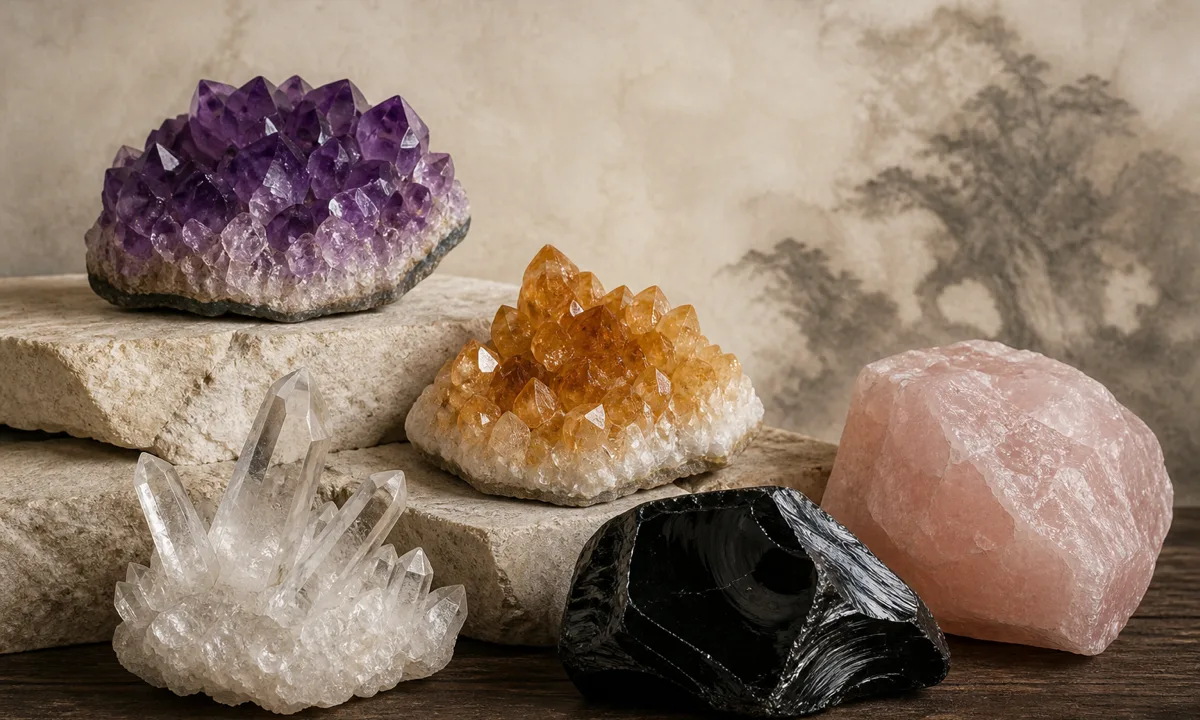
Amethyst is one of the most beloved crystals in the world — a purple variety of quartz that has appeared in royal regalia, temple art, and modern living rooms alike. Its meaning has been shaped by thousands of years of culture: from ancient Greek beliefs about the stone and wine, to its role in Buddhist traditions, to its modern use in feng shui as a stone of calm and clarity.
This guide covers amethyst meaning in depth: where the stone comes from, what its color symbolizes, how it is traditionally used in feng shui, how to choose and care for it, and how to bring it into your daily life.
What is amethyst?
Amethyst is a variety of quartz (silicon dioxide) colored purple by traces of iron and other minerals in its crystal structure. It ranks 7 on the Mohs hardness scale, which makes it durable enough for everyday jewelry. Fine amethyst is mined around the world — Brazil, Uruguay, and Zambia are among the best-known sources — and it ranges in color from pale lavender to deep violet.
| Amethyst fact | Detail |
|---|---|
| Mineral family | Quartz (silicon dioxide) |
| Color | Purple, from pale lavender to deep violet |
| Hardness | 7 on the Mohs scale |
| Main sources | Brazil, Uruguay, Zambia, and others |
| Notable varieties | Uruguayan deep violet, Zambian dark amethyst, and pale lavender stones |
| Traditional associations | Calm, clarity, wisdom, spiritual focus |
The word "amethyst" itself comes from the ancient Greek amethystos, meaning "not drunk" — a reference to the old belief that the stone could protect its wearer from intoxication. The Greeks also associated it with the god Dionysus, god of wine, and the stone's purple color has long been linked to royalty, dignity, and spiritual authority in many cultures.
Amethyst meaning and symbolism
Across traditions, amethyst carries a remarkably consistent set of meanings. These are cultural and spiritual associations — beliefs held and passed down over centuries, not scientific claims — and they give the stone its character:
- Calm and peace. Amethyst is traditionally associated with a quiet, restful mind. It is the stone people reach for when they want to slow down.
- Clarity and focus. The still, deep color is linked to clear thinking and cutting through mental noise.
- Wisdom and insight. In several traditions, purple is the color of higher understanding and reflection.
- Protection of the spirit. In Buddhist traditions, amethyst has been used in prayer beads and temple settings as an aid to meditation and focus.
In Chinese culture, purple has long carried an air of honor and mystery — "purple air from the east" (紫气东来) is a classical phrase for an auspicious arrival. Amethyst's purple therefore fits naturally into a cultural context where the color itself is considered dignified and meaningful.
Amethyst in feng shui
In feng shui, amethyst is most often used as a stone of calm, clarity, and intention. Placement is guided by the energy you want to create in a space, and the practice is about intention and arrangement rather than any mechanical effect. Common traditional uses:
| Placement | Intended purpose | Practical tip |
|---|---|---|
| Bedroom | A calm, restful atmosphere | Place on a nightstand or shelf away from electronics |
| Desk or study | Focus and mental clarity | Keep a cluster or small tower where you can see it |
| Meditation corner | Supporting focus and stillness | Place near your cushion or altar |
| Living room | A welcoming, grounding presence | Use a larger cluster as a natural decor piece |
| Entryway | A soft, gracious welcome | A small polished piece on a table or shelf |
A few feng shui guidelines people commonly follow: amethyst is generally considered a "yin" stone — quiet and receptive — so it suits spaces meant for rest and reflection more than high-energy work zones. Some practitioners associate deep purple with the fire element and use it in moderation in the south (fire) area of a home, while others simply place it where calm is needed. As with all feng shui practices, the meaningful part is your intention: the stone is a reminder and a focus for the atmosphere you want to create.
How to choose amethyst
Whether you are buying for decor, jewelry, or a gift, the same basic criteria apply:
- Color. Deeper, richer purple is generally more prized; look for even color without washed-out patches.
- Clarity. Translucent stones with fewer inclusions are usually considered higher quality, though some inclusions are natural and normal.
- Cut and polish. Check for smooth, even surfaces and sturdy settings in jewelry.
- Source honesty. Reputable sellers should tell you the stone's origin and whether it has been treated.
Price varies widely with color, size, and clarity — a small tumbled stone can be very affordable, while deep-violet clusters and high-grade faceted stones command higher prices. Buy from a seller who describes the stone honestly and offers clear photos.
How to cleanse and care for amethyst
Traditional care for amethyst is simple, and following it keeps the stone looking its best:
- Cleansing. Many people cleanse crystals by rinsing them gently in cool running water, placing them in moonlight overnight, or using incense smoke. These are traditional practices of intention, and they also keep the stone physically clean.
- Charging. Placing amethyst in indirect moonlight or a calm, quiet spot is a common way people "reset" the stone's energy.
- Sunlight caution. Prolonged direct sunlight can fade amethyst's color over time, so store and display it away from strong, constant sun.
- Everyday care. Wipe with a soft cloth; avoid harsh chemicals and ultrasonic cleaners for fragile settings.
Bringing amethyst into daily life
Amethyst works as well in daily life as it does in a dedicated space: a small pendant for calm presence, a tower on your desk for focus, a cluster by your bedside for rest. Its meaning — calm, clarity, wisdom — makes it a thoughtful gift and a natural fit for a home decorated with intention.
Whether you are drawn to it for its color, its history, or its feng shui associations, amethyst is a stone with centuries of meaning behind it. Like all crystal practices, its use is a cultural and spiritual tradition for self-reflection and atmosphere — if you have health concerns, always consult a qualified professional rather than relying on stones or beliefs alone.
---
Related reading
- Best feng shui tools of 2026 — crystals and tools compared
- Feng shui home office layout — bring calm and clarity to work
- Feng shui office desk placement — positioning for focus
- Five elements quiz — see which elements your space needs
- Feng Shui explained — the principles behind every placement
Frequently Asked Questions
What does amethyst mean?
Amethyst is traditionally associated with calm, clarity, and wisdom. Its name comes from the ancient Greek amethystos ("not drunk"), and its purple color has long been linked to royalty, dignity, and spiritual focus across many cultures, including Chinese tradition, where purple carries an air of honor and mystery.
What is amethyst used for?
Amethyst is used as jewelry, home decor, and a meditation aid. In feng shui, it is commonly placed in bedrooms for a calm atmosphere, on desks for focus, and in meditation corners for stillness. These are traditional cultural and spiritual practices of intention — not medical treatments.
Where should I place amethyst in my home?
Common placements include the bedroom (for a restful atmosphere), desk or study (for focus), meditation corner (for stillness), and living room (as a grounding decor piece). The meaningful part is your intention: place it where you want to create calm and clarity.
How can I tell if real amethyst?
Real amethyst is cool to the touch, has natural inclusions and color variation, and does not scratch easily (it ranks 7 on the Mohs scale). Deeply uniform, bubble-filled, or suspiciously cheap "amethyst" may be glass or synthetic. Buy from a seller who states the origin and shows clear photos.
Does amethyst have healing properties?
Amethyst carries traditional associations with calm and clarity, and these are cultural and spiritual beliefs, not medical claims. If you have health concerns — sleep problems, stress, or anything else — consult a qualified professional. Crystal practices are for atmosphere, intention, and self-reflection.