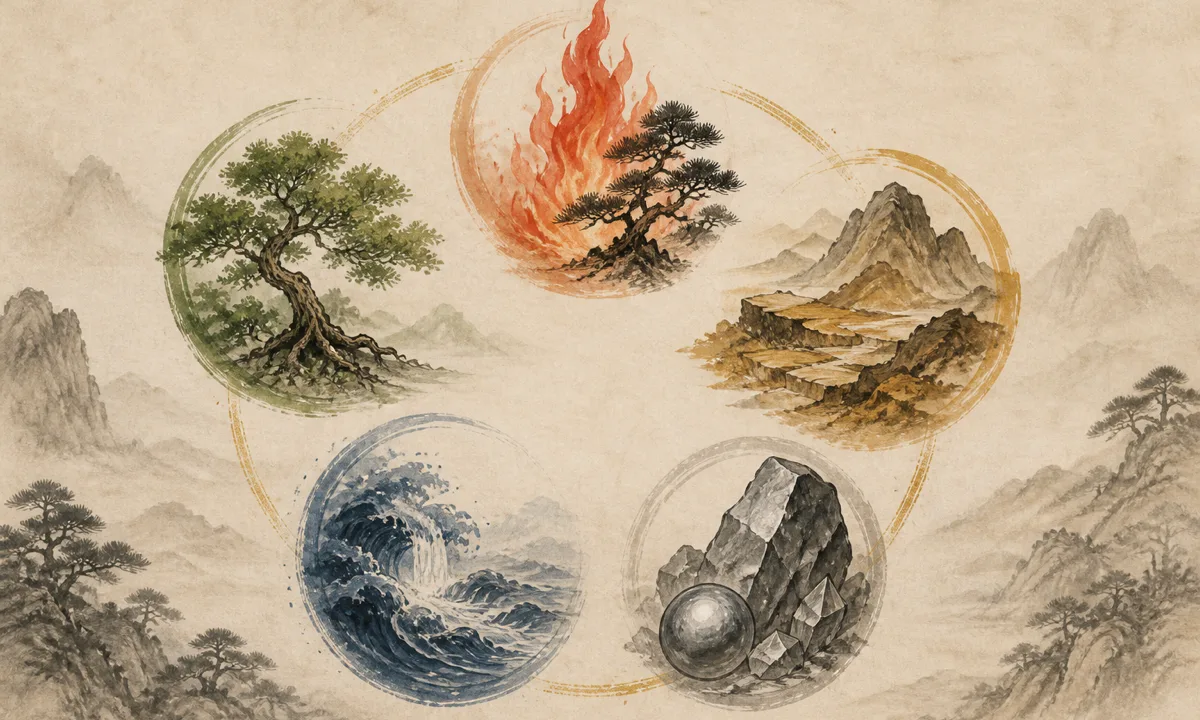
A five elements quiz is one of the most popular ways to begin exploring Chinese metaphysics. In a few minutes, it maps your everyday patterns — how you react, what drains you, how you relate to others — onto the five elements of Wood, Fire, Earth, Metal, and Water. The result is a snapshot of your element balance: which elements run strong in your nature, which run low, and what that means for how you live and work.
This guide explains how a five elements quiz works, what the five elements actually measure, how to read your results, and the practical, culturally grounded ways people use element balance in daily life.
What is a five elements quiz?
A five elements quiz is a self-assessment tool based on the Five Elements (五行) framework at the heart of Chinese philosophy and BaZi (Four Pillars) astrology. Instead of asking for your birth date, the quiz asks about your behavior and preferences — how you handle stress, what kind of environment energizes you, how you make decisions — and maps your answers to element patterns.
The idea behind it is simple and practical: everyone contains all five elements, but in different proportions. Some people are Wood-heavy (growth-oriented, initiating), some Fire-heavy (expressive, warm), some Earth-heavy (stable, reliable), some Metal-heavy (precise, principled), and some Water-heavy (perceptive, adaptive). A quiz gives you a starting point for seeing your own proportions.
For a deeper, chart-based version of the same idea, BaZi reading uses your exact birth date and time to calculate the element distribution of your entire chart. The quiz is a friendly entry point; the chart is the full map.
The five elements at a glance
Each element carries a core character that shows up in people and in nature. Here is the shorthand:
| Element | Core keyword | How it shows up in people |
|---|---|---|
| Wood (木) | Growth | Plans, builds, initiates; happiest when something is growing |
| Fire (火) | Passion | Expresses, connects, energizes; drawn to visibility and warmth |
| Earth (土) | Stability | Nurtures, anchors, builds systems; reliable under pressure |
| Metal (金) | Precision | Structures, prunes, decides; values quality and standards |
| Water (水) | Wisdom | Perceives, adapts, goes deep; stays calm and thinks in layers |
No element is "better" than another. Each has strengths and blind spots, and balance — not dominance — is the goal in the classical framework. A person with strong Wood and weak Metal, for example, may start projects easily but struggle to finish and prune; a person with strong Metal and weak Fire may be disciplined but guarded with warmth.
How to read your quiz results
Most five elements quizzes report a distribution — something like "Wood 30%, Fire 20%, Earth 25%, Metal 15%, Water 10%." Here is how to interpret it:
- Your dominant element describes your default mode: how you naturally respond when you are not trying to be someone else. Read its traits first.
- Your secondary elements show the supporting cast — the energies you draw on when the situation demands it.
- Your low elements are not flaws. In the classical view, they are the energies you have less natural access to, which is why a balanced practice includes them deliberately.
A useful follow-up question is: which elements support which? In the generation cycle, Wood feeds Fire, Fire feeds Earth, Earth feeds Metal, Metal feeds Water, and Water feeds Wood. In the controlling cycle, Wood controls Earth, Earth controls Water, Water controls Fire, Fire controls Metal, and Metal controls Wood. Your quiz results become more meaningful when you look at your low elements through these cycles — they are often exactly the energies your dominant element needs.
How to bring your elements into balance
Balance work in the Five Elements tradition is practical and everyday. It is not about changing who you are; it is about giving your weaker energies regular exposure. Common culturally grounded practices include:
| Area | How people work with it |
|---|---|
| Color | Wearing or surrounding yourself with the color of a needed element |
| Environment | Placing objects, plants, or crystals that carry a needed element's energy |
| Activity | Choosing activities that exercise a weaker element — e.g., rest and reflection for Wood-heavy people |
| Relationships | Spending time with people whose dominant element complements yours |
For example, a Water-heavy person (perceptive but prone to overthinking) might deliberately add Fire elements — warm colors, expressive activity, social time — to bring more warmth and spontaneity into the mix. These are cultural practices for self-exploration and lifestyle, not medical or psychological treatments.
Where to go deeper
A quiz is a snapshot; a BaZi chart is a map. If your quiz results made you curious, the natural next step is to generate your free BaZi chart, which calculates your Day Master and full element distribution from your birth date and time. From there, a professional reading can walk you through what your element balance means for career, relationships, and life timing — in a structured, culturally grounded way.
Whatever path you choose, the framework's purpose stays the same: self-exploration. Knowing your element balance gives you a language for your own patterns — and that knowledge, more than any single result, is the practical benefit.
---
Related reading
- Water element personality — the deep, perceptive side of the elements
- Wood element personality — growth, initiative, and vision
- Chinese zodiac elements: the complete guide — animals and their elements
- How to find your BaZi chart free online — go from quiz to chart
- Five Elements explained — the system behind every personality
Frequently Asked Questions
What is a five elements quiz?
A five elements quiz is a self-assessment that maps your behavioral patterns — how you react, what energizes you, how you relate to others — onto the five elements of Wood, Fire, Earth, Metal, and Water. It reports your element distribution so you can see which elements are strong and weak in your nature.
How accurate is a five elements quiz?
A quiz is a useful starting point, not a precise measurement. It reflects how you see yourself, so honesty matters more than the number of questions. For a chart-based analysis, a BaZi reading calculates your element distribution from your exact birth date and time — the traditional, more detailed method.
What are the five elements?
Wood, Fire, Earth, Metal, and Water. Wood is growth, Fire is passion, Earth is stability, Metal is precision, and Water is wisdom. They relate through a generation cycle (Wood to Fire to Earth to Metal to Water) and a controlling cycle (Wood over Earth, Earth over Water, Water over Fire, Fire over Metal, Metal over Wood).
Can I change my element balance?
You cannot change the elements in your birth chart, and the tradition does not ask you to. Balance work is about lifestyle — colors, environment, activities, and relationships that give your weaker elements regular exposure. The goal is harmony with your nature, not transformation of it.
Is the five elements quiz the same as a zodiac test?
No. Zodiac tests are usually based on your birth-year animal (Rat, Ox, Tiger, and so on). A five elements quiz measures your overall element distribution, which in BaZi is anchored by your Day Master rather than your birth-year sign. The two are different layers of the same system.