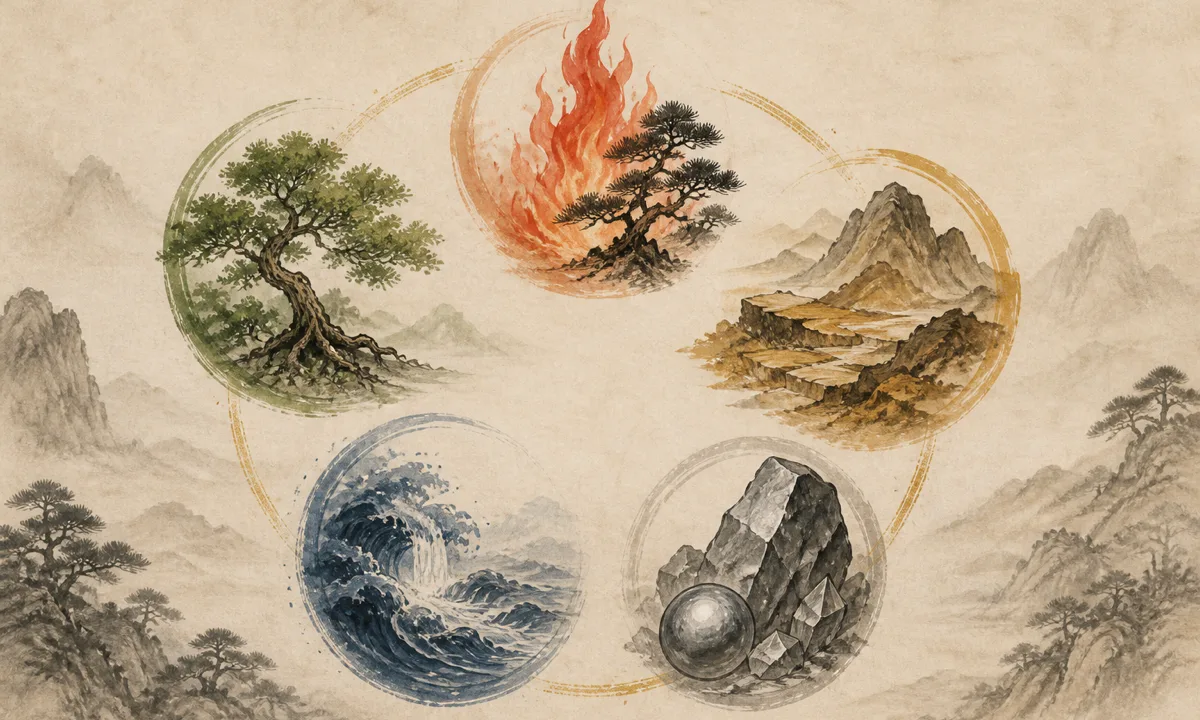
In the Five Elements system that underpins Chinese metaphysics, Wood (木) is the element of growth. Spring is its season, the east is its direction, and its motion is upward and outward — like a tree reaching for light. As a personality lens, the wood element describes people who grow, initiate, and build toward something larger than themselves.
This guide maps the wood element personality in detail: the core traits, the strengths and blind spots, how Wood relates to the other elements, and how to work with a Wood-dominant nature — whether that is your own or someone close to you.
What is the wood element?
In the classical framework, Wood is one of the five fundamental qualities — Wood, Fire, Earth, Metal, and Water — that describe patterns in nature and in people. Each element carries a character: Wood is the growing thing, the seedling that pushes through soil, the tree that stands tall. The classical Chinese character for its nature is 生发 — sprouting and unfolding — with the quality of 条达, meaning smooth, straight, and unobstructed growth.
| Wood element | Classical attribute |
|---|---|
| Season | Spring (春) |
| Direction | East (东) |
| Color | Green (青绿) |
| Stems | Jia (甲, Yang Wood) and Yi (乙, Yin Wood) |
| Branches | Tiger (寅) and Rabbit (卯) |
| Virtue | Benevolence (仁) |
| Image | The tree: upward, outward, rooted |
There are two faces of Wood in the stem system. Jia Wood (甲) is the great tree — direct, pioneering, and visible, the energy that opens new ground. Yi Wood (乙) is the vine and flower — flexible, adaptive, and quietly persistent, the energy that finds a way around obstacles. Most people carry elements of both; which one dominates depends on the balance in their chart.
Core wood element personality traits
A person with strong Wood in their chart tends to show a recognizable pattern. These are tendencies from the cultural framework — descriptions of nature, not verdicts — but they are strikingly consistent:
| Trait | How it shows up |
|---|---|
| Growth-oriented | Always learning, improving, or starting something new |
| Idealistic | Holds a clear vision of how things should be |
| Driven | Strong inner motivation; restlessness when progress stalls |
| Principled | Cares about fairness and doing the right thing |
| Expansive | Naturally organizes, plans, and builds structures |
| Impatient | Wants results now; dislikes waiting and bureaucracy |
The signature of Wood personality is forward motion. Wood people are often the ones who turn ideas into projects, who plant the seed that others later harvest. In work and life, they are happiest when there is something to grow — a skill, a team, a business, a vision.
Strengths of the wood element personality
- Vision and initiative. Wood people see what could be and start building it. They do not wait for permission.
- Fairness and loyalty. The virtue associated with Wood is benevolence (仁). Wood personalities tend to protect their people and champion the underdog.
- Natural planning. Like a tree that grows in a shape, Wood people think in structures — roadmaps, timelines, growth plans.
- Resilience. A tree bends in the wind and keeps growing. Wood personalities recover and regrow after setbacks.
Blind spots to watch
- Impatience. Growth takes time, and Wood people often want to skip the waiting. The result can be starting too many things at once.
- Rigidity. When a vision hardens, Wood becomes a trunk that will not bend — conflicts follow when reality does not match the plan.
- Pushing too hard. Growth energy, applied without rest, becomes burnout. Wood people need seasons of dormancy too.
The classical balancing answer for Wood's excess is the other elements: Fire gives its ambition direction and visibility, Earth gives its growth a place to root, and Water gives it the nourishment to keep growing. The element that most challenges Wood is Metal, which cuts it back — experienced as friction with authority, criticism, or deadlines, but also as the pruning that makes growth healthier.
Wood in the Five Elements cycle
Every element both supports and is supported by its neighbors. Knowing where Wood sits in the cycle explains a lot about Wood personality relationships:
| Relationship | Element | What it means for Wood |
|---|---|---|
| Wood generates | Fire (木生火) | Wood's ideas become Fire's expression — Wood people often feed creative, visible work |
| Wood is nourished by | Water (水生木) | Water brings depth and resilience — Wood personalities benefit from rest and reflection |
| Wood is controlled by | Metal (金克木) | Metal cuts and prunes — experienced as discipline, criticism, or pressure |
| Wood controls | Earth (木克土) | Wood shapes and moves Earth — Wood people naturally organize and direct |
In relationships, Wood tends to pair most comfortably with Fire (mutual inspiration — the Fire person brings Wood's ideas into the open) and Water (the Water person's depth soothes Wood's restlessness). Wood and Earth can work well when the Earth partner provides stability and the Wood partner provides direction. The friction point is Wood with Metal — not a bad pairing, but one that needs conscious respect for each other's pace.
Career directions for Wood personalities
The classical imagery is a useful guide: Wood is the growing, organizing, expanding element. Wood-dominant people often thrive in:
- Startups, product, and project leadership — building something from nothing
- Education and coaching — growing people as well as things
- Creative industries and content — Wood's vision feeds Fire's output
- Planning and strategy roles — the natural structural thinker
- Any role with visible progress — Wood needs to see the tree getting taller
The environments that drain Wood are the opposite: rigid hierarchies with no room to grow, repetitive work with no visible progress, and workplaces where initiative is punished.
How to find out if you are a Wood personality
The Five Elements in your chart are not a single label — everyone contains all five, in different proportions. In BaZi (the Four Pillars system), your Day Master is the stem of your day pillar, and its element is your nature element. A person whose Day Master is Jia (甲) or Yi (乙) is considered Wood-natured, and the strength of Wood in their chart shows how dominant the trait is.
If you are curious about your own balance, the practical first step is to generate your chart — a free BaZi calculator will show your Day Master and element counts. From there, the wood element personality described here is a lens for understanding your patterns, not a box you are locked into. The framework's purpose is self-exploration: knowing your nature helps you choose environments and habits that fit it.
---
Related reading
- Fire element personality — expressive, passionate, magnetic
- Earth element personality — stable, reliable, nurturing
- Metal element personality — decisive, disciplined, precise
- How to find your BaZi chart free online — find your Day Master
- Five Elements explained — the system behind every personality
Frequently Asked Questions
What are the traits of a wood element personality?
Wood personalities are growth-oriented, idealistic, and driven. They think in plans and structures, care about fairness, and are happiest when something is growing — a skill, a project, a team, or a vision. Their main struggles are impatience and occasional rigidity when reality does not match the plan.
How do I know if my element is Wood?
In BaZi, look at your Day Master — the Heavenly Stem of your day pillar. If it is Jia Wood (甲) or Yi Wood (乙), Wood is your nature element. A free chart generator will show your Day Master and how strong Wood is in your overall element balance.
Which element is compatible with Wood?
In the generation cycle, Water nourishes Wood and Wood feeds Fire, so Water and Fire personalities tend to harmonize most naturally with Wood. Metal challenges Wood — experienced as friction with discipline or authority — which is a pairing that needs conscious mutual respect rather than a sign of incompatibility.
What is the difference between Jia Wood and Yi Wood?
Jia Wood (甲) is Yang Wood — the great tree: direct, pioneering, and visible, the energy that opens new ground. Yi Wood (乙) is Yin Wood — the vine and flower: flexible, adaptive, and quietly persistent, the energy that finds a way around obstacles. Most charts contain both; which dominates shapes how the Wood nature expresses itself.
Is the wood element personality the same as a zodiac animal?
No. The zodiac animal (like Tiger or Rabbit) is one layer of the system, and those animals happen to belong to the Wood branch. The wood element personality is broader — it is about how much Wood energy shapes a person's nature across the whole chart, which in BaZi is anchored by the Day Master, not the birth-year animal alone.