In the Five Elements system of Chinese metaphysics, Earth (土) is the quiet center. Its nature is 稼穑 — the soil that receives seed and grows food — and its direction is the middle, which in the classical scheme is where everything returns. As a personality lens, Earth describes people who hold things together: the reliable, nurturing, steady presence others lean on.
This guide maps the earth element personality in detail: the core traits, the strengths and blind spots, how Earth relates to the other elements, and how to work with an Earth-dominant nature.
What is the earth element?
Earth is the element of stability, nourishment, and containment. In the classical texts it is 稼穑 — planting and harvesting, the soil itself: it receives, holds, transforms, and gives back. Its virtue is trust (信), and its season is the "long summer" — the turning point between seasons, which suits an element that stands between everything.
| Earth element | Classical attribute |
|---|---|
| Season | Long summer / season transitions (长夏) |
| Direction | Center (中) |
| Color | Yellow (黄) |
| Stems | Wu (戊, Yang Earth) and Ji (己, Yin Earth) |
| Branches | Dragon (辰), Dog (戌), Ox (丑), Goat (未) |
| Virtue | Trust (信) |
| Image | Soil: receives, holds, nourishes |
Earth also has two faces in the stem system. Wu Earth (戊) is the mountain and city wall — strong, immovable, protective, the great shelter. Ji Earth (己) is the garden field — fertile, soft, and nurturing, the soil that grows crops. Mountain-earth personalities are the fortress; field-earth personalities are the nourishment.
Core earth element personality traits
A person with strong Earth in their chart tends to show a recognizable pattern. These are tendencies from the cultural framework, not verdicts, but they are consistent:
| Trait | How it shows up |
|---|---|
| Reliable | Follows through; others count on them |
| Nurturing | Cares for people practically — food, shelter, stability |
| Patient | Comfortable with slow, steady progress |
| Loyal | Stays; does not abandon |
| Grounded | Calm under pressure; hard to rattle |
| Risk-averse | Prefers the known; change is metabolized slowly |
The signature of Earth personality is dependability. Earth people are the ones others call in a crisis, the ones who remember birthdays and bring food, the ones who quietly make sure the project ships. They feel most valued when they are useful — when their steadiness lets someone else move faster.
Strengths of the earth element personality
- Trustworthiness. The virtue of Earth is trust (信). Earth people keep their word, which is why they collect long relationships.
- Stability under pressure. Where others panic, Earth holds. They are the calm in the room.
- Practical care. Earth nurtures in concrete ways — meals, money saved, houses kept, systems maintained.
- Containment. Earth holds everything together: teams, families, budgets, routines. Without Earth, the structure has no foundation.
Blind spots to watch
- Resistance to change. Earth holds on. Major transitions — new jobs, moves, endings — are processed slowly and often resisted.
- Self-neglect. Earth gives so much to holding others that it forgets to be held. Exhaustion hides behind calm.
- Over-caution. Risk-aversion becomes missed opportunity; Earth can wait so long for certainty that the moment passes.
- Difficulty saying no. Being the dependable one means being asked to absorb everyone else's weight.
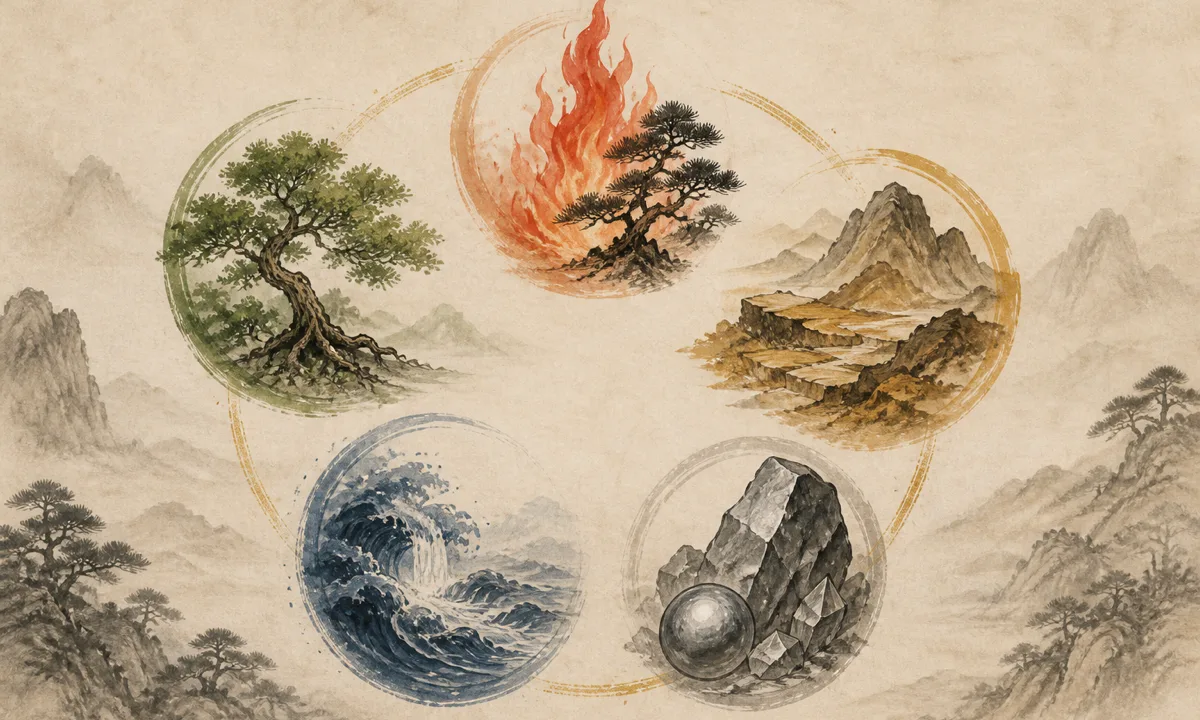
The classical balance for Earth is Wood and Water. Wood (木克土) breaks up and aerates the soil — change, challenge, and movement keep Earth from hardening. Water nourishes Earth's field and keeps it fertile, though too much water can flood it. Metal digs and shapes Earth into useful forms — which is why Earth personalities often partner well with Metal's decisiveness.
Earth in the Five Elements cycle
Knowing where Earth sits in the cycle explains a lot about Earth personality relationships:
| Relationship | Element | What it means for Earth |
|---|---|---|
| Earth generates | Metal (土生金) | Earth's stability becomes Metal's structure — Earth people build the systems others refine |
| Earth is nourished by | Fire (火生土) | Fire's warmth feeds the soil — Earth personalities are warmed by Fire's energy |
| Earth is controlled by | Wood (木克土) | Wood breaks up the soil — change and challenge keep Earth from hardening |
| Earth controls | Water (土克水) | Earth dams and channels Water — Earth people manage and direct emotional floods |
In relationships, Earth pairs most comfortably with Fire (the Fire partner's warmth and energy brings life to Earth's steadiness) and Metal (Metal's sharp decisiveness meets Earth's patience — each supplies what the other lacks). Earth with Water works when the Water partner's depth is channeled rather than flooding. The friction point is Earth with Wood — not a bad pairing, but Wood's constant change can exhaust Earth's need for stability.
Career directions for Earth personalities
The classical imagery guides well: Earth is support, stability, and care. Earth-dominant people often thrive in:
- Operations, administration, and project management — the person who makes things actually ship
- Finance, accounting, and real estate — stability and accumulation of resources
- Healthcare, caregiving, hospitality, and education — practical nurturing
- Agriculture, food, and property — the classical domains of the element
- Any role where trust is the product — Earth people are the backbone of organizations
Environments that drain Earth: constant chaos, endless restructuring, environments where reliability is not rewarded, and workplaces that value flash over follow-through.
How to find out if you are an Earth personality
In BaZi, your Day Master is the stem of your day pillar, and its element is your nature element. A person whose Day Master is Wu (戊) or Ji (己) is considered Earth-natured, and the strength of Earth in the chart shows how dominant the trait is. A free chart generator will show your Day Master and element counts.
The framework is a lens for self-exploration, not a verdict. Knowing you carry strong Earth helps you protect your own stability instead of only providing it — and to say yes to change a little more often.
---
Related reading
- Wood element personality — what keeps Earth from hardening
- Fire element personality — the warmth that feeds Earth
- Metal element personality — what Earth shapes
- How to read a BaZi chart — the pillar-by-pillar guide
- Five Elements explained — the system behind every personality
Frequently Asked Questions
What are the traits of an earth element personality?
Earth personalities are reliable, nurturing, and patient. They keep their word, stay calm under pressure, and care for people in practical ways. Their strengths are trustworthiness and stability; their challenges are resistance to change, self-neglect, and difficulty saying no.
How do I know if my element is Earth?
In BaZi, look at your Day Master — the Heavenly Stem of your day pillar. If it is Wu Earth (戊) or Ji Earth (己), Earth is your nature element. A free chart generator will show your Day Master and the strength of Earth in your element balance.
Which element is compatible with Earth?
Fire nourishes Earth (火生土), so Fire personalities warm and enliven Earth's steadiness. Metal is the practical match — Earth builds the foundation, Metal shapes it into form. Wood challenges Earth by constantly changing the ground, which is the friction point that also keeps Earth from hardening.
What is the difference between Wu Earth and Ji Earth?
Wu Earth (戊) is Yang Earth — the mountain and city wall: strong, immovable, protective. Ji Earth (己) is Yin Earth — the garden field: fertile, soft, nurturing. Mountain-earth personalities are the fortress; field-earth personalities are the nourishment.
Is the earth element personality the same as a zodiac animal?
No. The zodiac animal (like Dragon or Ox) is one layer of the system, and those animals happen to belong to the Earth branch. The earth element personality is broader — it is about how much Earth energy shapes a person's nature across the whole chart, anchored by the Day Master in BaZi rather than the birth-year animal alone.