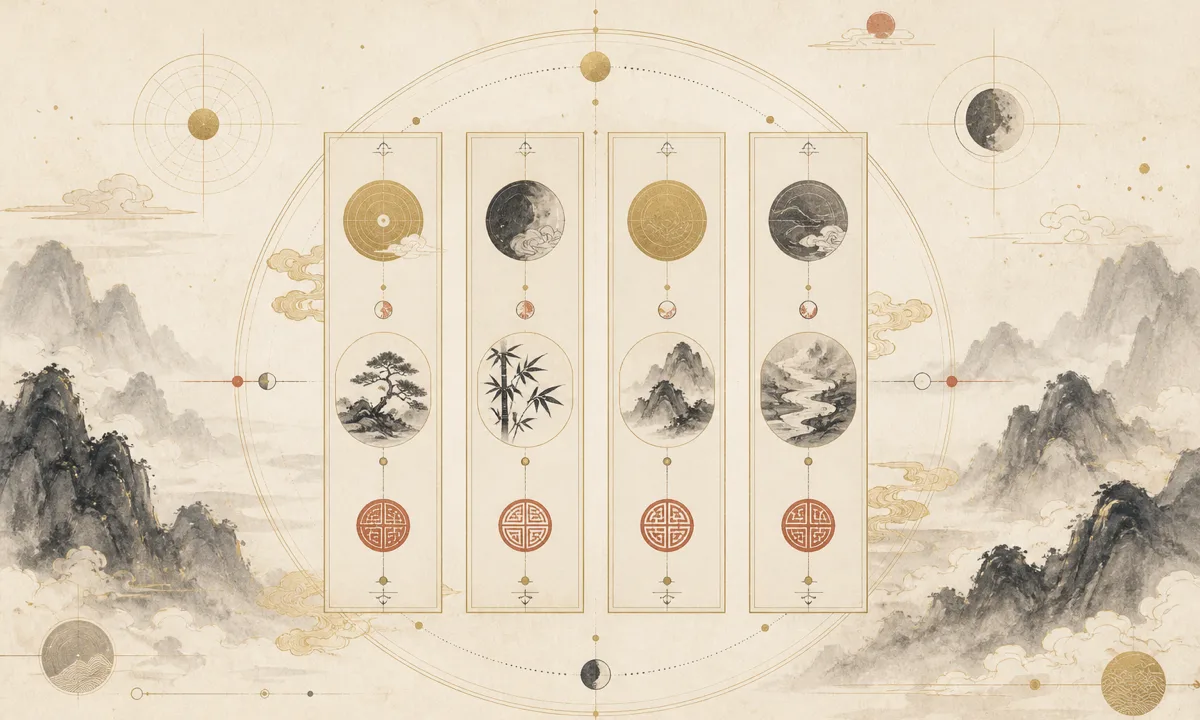
A BaZi chart — the Four Pillars of Destiny — looks like a simple grid of eight Chinese characters. Behind it is a 1,000-year-old system for reading your inherent patterns: your strengths, your blind spots, and the seasons of your life.
This guide walks through reading a chart step by step, using plain language. No memorized poetry required.
What the four pillars are
The chart has four columns — one for each pillar of your birth data:
| Pillar | What it represents | Your info used |
|---|---|---|
| Year pillar | Early years, family background, grandparents | Birth year (lunar, by solar terms) |
| Month pillar | Young adulthood, career direction, parents | Birth month (by solar terms) |
| Day pillar | Your core self (Day Master), partner | Birth day — the most important |
| Hour pillar | Later years, children, inner thoughts | Birth hour |
Each pillar has a Heavenly Stem (top character) and an Earthly Branch (bottom character) — eight characters total.
Step 1: Find your Day Master
The Day Master (日主) is the Heavenly Stem of the Day Pillar — the character that represents YOU. Everything else in the chart is read in relation to it. If your Day Master is Wood (甲 or 乙), you are a "Wood person"; Metal, a "Metal person," and so on.
Your Day Master determines your core temperament and what elements support or drain you.
Step 2: Check your element balance
Count how many times each of the five elements appears across the eight characters (including hidden stems). The chart usually shows a pattern:
| Element | In balance | Imbalanced (excess) |
|---|---|---|
| Wood | Growth, flexibility | Stubbornness, scattered plans |
| Fire | Warmth, visibility | Overheating, impulsiveness |
| Earth | Stability, reliability | Stagnation, worry |
| Metal | Precision, boundaries | Rigidity, isolation |
| Water | Depth, wisdom | Overthinking, indecision |
The missing or excessive elements point to your growth edges — not flaws, just weather patterns.
Step 3: Look at the Month Pillar for your season
The Month Pillar tells you the "season" you were born into and shapes your career direction. A person with a strong Month influence leans toward that element's industries: Wood toward education and media, Fire toward tech and design, Earth toward real estate and agriculture, Metal toward law and finance, Water toward travel and research.
Step 4: Read the Ten Gods
The Ten Gods describe how each character relates to your Day Master. The four that matter most for beginners:
| Ten God | What it shows |
|---|---|
| Resource (印) | Learning, support, mother-like care |
| Output (食伤) | Talent, expression, creativity |
| Wealth (财) | Money, resources, practical results |
| Authority (官杀) | Career, pressure, responsibility |
Where these appear strongly in your chart, your life tends to emphasize that theme.
Step 5: Look at the Luck Pillars
Each Luck Pillar (大运) covers 10 years of your life and describes the flavor of that decade. A chart is not a fixed destiny — the Luck Pillars show which seasons of your life support which kinds of action. A "weak" decade calls for building; a "strong" one calls for bold moves.
A worked example (simplified)
Take a chart with a Wood Day Master born in a Fire-heavy month:
- Day Master: Wood (needs support)
- Season: Fire month (drains Wood — the person is "light on fuel")
- What helps: Water (nourishes Wood) and Metal? No — Water and Earth. Water feeds Wood; Earth is not essential here.
- Practical read: This person thrives with rest, learning, and steady support; rushing into many projects at once drains them. Their best work comes in structured environments with calm routines.
What a reading gives you
A BaZi reading turns the chart into practical guidance: your favorable elements, your natural strengths, which years to move fast, and which to consolidate. It is a map of your patterns — not a fortune-telling service, but a framework for self-understanding.
---
Related reading
- Free BaZi calculator — see your own chart
- Five Elements hub — the pillar guide
- What is BaZi? — the Four Pillars explained
- What is a Day Master?
- How to find my BaZi chart free online — free tools
- Five elements compatibility
Frequently Asked Questions
What is a Day Master in BaZi?
The Day Master is the Heavenly Stem of your Day Pillar — the core character representing you. It determines your element (Wood, Fire, Earth, Metal, or Water) and your fundamental temperament. Everything else in the chart is read in relation to it.
Can I read my own BaZi chart?
Yes, with practice. Start with your Day Master and element balance, then add the Month Pillar and Ten Gods. Free calculators can generate the chart; the interpretation skills build over time. For important decisions, a trained reader adds depth.
How accurate is BaZi reading?
BaZi is a cultural framework for understanding patterns, not a predictive science. It is most useful for self-reflection: recognizing strengths, blind spots, and timing. Many people find it accurate in describing tendencies, while treating it as one lens among many.
Do I need my birth time to read my chart?
The birth time is needed for the Hour Pillar, which refines the picture (later years, children, inner self). Without it, you can still read the Year, Month, and Day pillars — roughly 75% of the chart. A birth time estimate or "unknown" reading still gives useful insight.
What does a BaZi reading include?
A typical reading covers your Day Master and element balance, strengths and blind spots, favorable elements and directions, career tendencies, and the rhythm of your Luck Pillars — the major life seasons. Some readings add compatibility and annual forecasts.