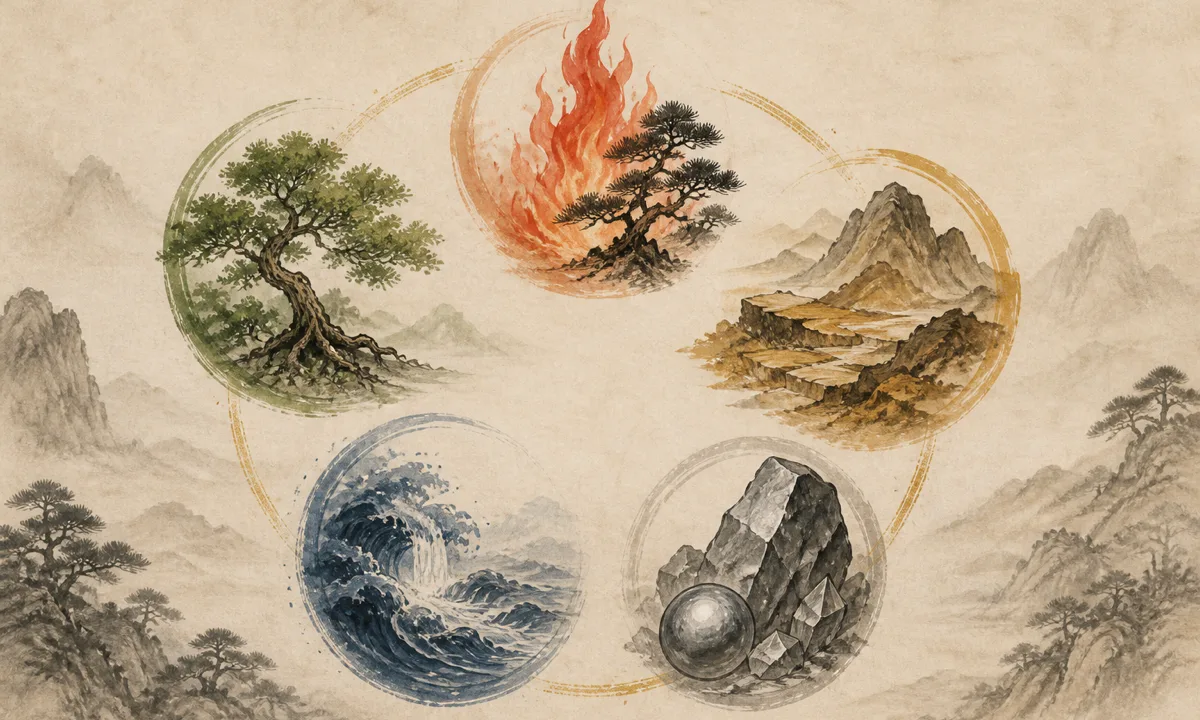
Quick answer: In the Five Elements system, compatibility runs on two cycles. The generating cycle (Wood→Fire→Earth→Metal→Water→Wood) describes elements that nourish each other. The controlling cycle (Wood→Earth→Water→Fire→Metal→Wood) describes elements that balance or temper each other. In relationships, the most harmonious pairings tend to follow the generating cycle — but real compatibility comes from reading two complete charts, not just two element labels.

---
The two cycles, clearly
Generating cycle (相生 — mutual nourishment):
| Element | Feeds | Result |
|---|---|---|
| Wood 木 | Fire 火 | Wood fuels fire |
| Fire 火 | Earth 土 | Fire creates ash → earth |
| Earth 土 | Metal 金 | Earth bears metal |
| Metal 金 | Water 水 | Metal condenses water |
| Water 水 | Wood 木 | Water nourishes wood |
Controlling cycle (相克 — mutual balance):
| Element | Controls | Result |
|---|---|---|
| Wood 木 | Earth 土 | Roots hold soil |
| Earth 土 | Water 水 | Earth dams water |
| Water 水 | Fire 火 | Water extinguishes fire |
| Fire 火 | Metal 金 | Fire melts metal |
| Metal 金 | Wood 木 | Metal cuts wood |
A common misconception (important to flag)
Many compatibility guides simplify this to "Water is compatible with Wood" or "Fire clashes with Water." That is the label level — and it is misleading. Your BaZi chart contains all five elements in different strengths; you are a balance, not a label. "I'm a Fire person" is shorthand for "Fire runs high in my chart" — the other four elements are still there.
This is exactly why QI KIND reads two full charts for compatibility rather than two element tags. A relationship reading compares:
- Core rhythm — do your Day Masters create or drain each other?
- Elemental support — does your balance cover your partner's quiet elements?
- Communication style — how do your dominant elements express conflict and care?
- Timing alignment — are your current life phases moving in compatible directions?
What "good compatibility" actually means
The healthiest pairings are not "same element" (too much of one energy) or "controlled element" (constant friction). The most supportive pairings are usually generating-cycle partners — where one person's strength nourishes the other's quiet spots. Example: if your chart runs strong Water and your partner's chart runs strong Wood, your Water nourishes their Wood — a classic supportive dynamic.
But the honest answer: two complete charts will always have harmony and tension somewhere. Compatibility is not about finding a "perfect match" — it is about understanding where the support is, where the friction is, and how to work with both. That is what a real reading is for.
How to check your own
- Generate your free chart to see your Five Elements balance
- Compare with your partner's balance using the cycles above
- For a real answer, use the marriage compatibility reading — two charts, four dimensions, plain language
A note on approach
Like the rest of Chinese metaphysics, Five Elements compatibility is a framework for reflection — a way to see patterns in how two people energize each other. It is a lens, not a verdict.
Frequently Asked Questions
Which Five Elements are most compatible?
Elements that follow the generating cycle (Wood-Fire, Fire-Earth, Earth-Metal, Metal-Water, Water-Wood) tend to support each other. But real compatibility depends on two full charts, not two element labels.
Is 'I am a Fire element' enough to check compatibility?
No. Your chart contains all five elements in different strengths — Fire is shorthand for your dominant element. Accurate compatibility requires reading both complete charts.
Can incompatible elements still work as a couple?
Yes. Every two charts have both harmony and tension. The goal is understanding where the support and friction are, not finding a perfect label match.
Where can I get a Five Elements compatibility reading?
QI KIND offers a marriage compatibility reading that compares two full BaZi charts across core rhythm, element support, communication style and timing alignment.
---
Related reading