In brief
Five Elements analysis is not a hunt for whichever element is missing. It studies how Wood, Fire, Earth, Metal and Water interact as dynamic phases, then asks which relationships help the complete chart function with greater balance.
Key takeaways
- Wuxing is better translated as Five Phases: the model describes change and relationship, not five fixed substances.
- An element that is absent on the surface may appear in hidden stems or later timing.
- The least abundant element is not automatically the most supportive one.
- Colors are symbolic lifestyle cues, not remedies or guarantees.
Why are Five Elements a cycle rather than five boxes?
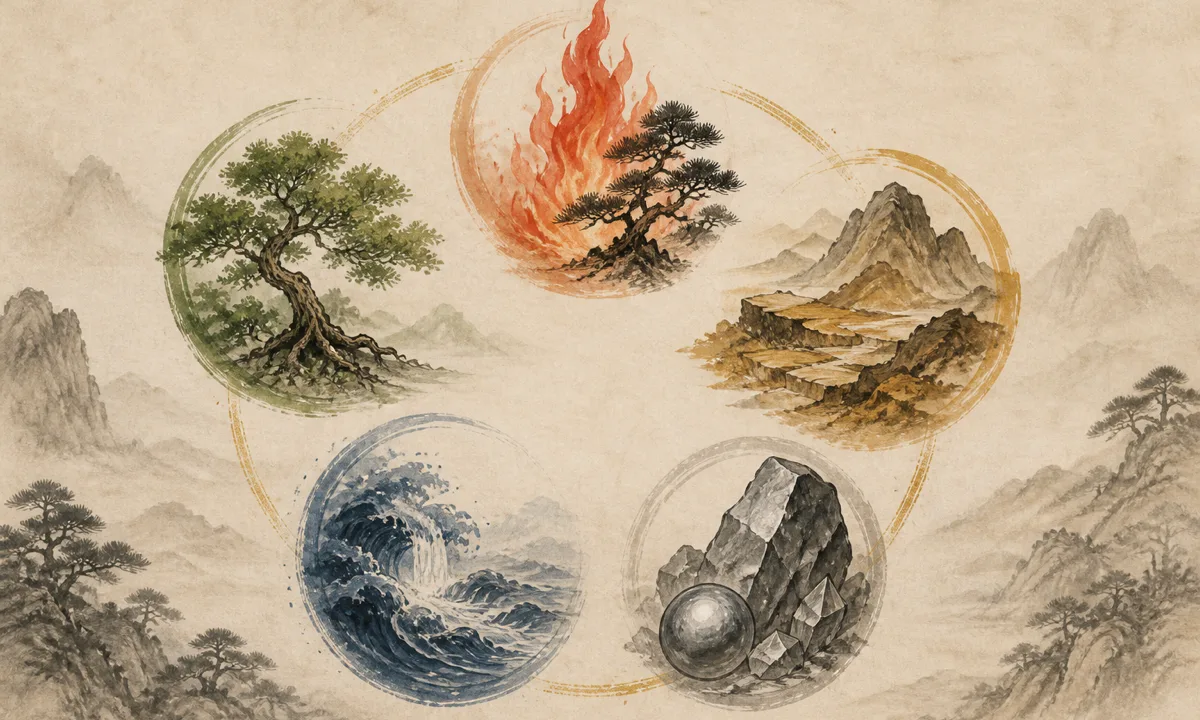
Wood feeds Fire, Fire creates Earth, Earth bears Metal, Metal enriches Water, and Water nourishes Wood. The controlling cycle adds another layer of regulation. In a chart, each element matters through what it does and how it relates to the whole.
That means an element absent from the visible eight characters is not automatically a prescription. It may appear in hidden stems, arrive through timing, or be less useful than another element that stabilizes the structure.
Why is a scarce element not always supportive?
A scarce element can still be unhelpful if it intensifies an imbalance. A plentiful element can sometimes be useful because it provides the right outlet or support. The question is not simply ‘How much?’ but ‘What role does it play?’
Color suggestions in a BaZi reading are therefore symbolic ways to dress the balance. They can be a gentle design cue for clothing, spaces or objects—not a promise that one color will change an outcome.
How can you keep Five Elements practice grounded?
Use Five Elements language to notice patterns and make small, reversible experiments. If a cooler palette helps a high-pressure season feel calmer, that lived response matters more than rigidly following a chart.
For medical, legal, financial or safety decisions, rely on qualified professional advice. Cultural symbolism can support reflection; it should not replace evidence or expertise.
How can you use Five Elements guidance responsibly?
Treat element guidance as a reflection tool and test it through small, reversible choices.
- Start with the complete chart result rather than a standalone online element counter.
- Separate visible frequency from the chart’s stated supportive or challenging relationships.
- Use suggested colors as optional accents in clothing, objects or spaces—not compulsory rules.
- Observe your real response over time and stop any change that is impractical or uncomfortable.
- Use qualified professionals for health, legal, financial and safety decisions.
Sources
- Internet Encyclopedia of Philosophy — Wuxing - Overview of Wuxing as dynamic, interdependent phases and its historical development.
- Stanford Encyclopedia of Philosophy — Metaphysics in Chinese Philosophy - Reference for generation and overcoming cycles within Chinese theories of change.