
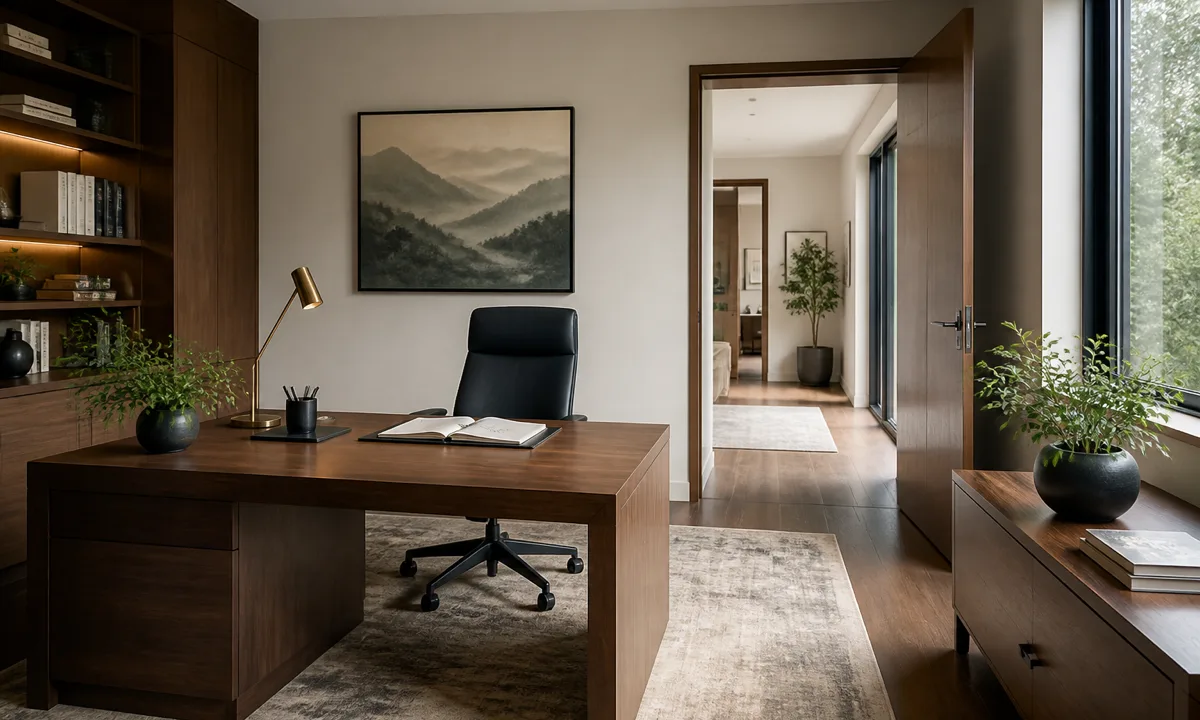
Working from home blurs the line between rest and work — and feng shui is built for exactly this problem: creating clear energetic zones in shared space. These 12 rules turn a room (or a corner) into a place where deep work happens.
The 12 rules
| # | Rule | Why it matters |
|---|---|---|
| 1 | Give the office its own zone | Clear boundary = clear mind |
| 2 | Desk in commanding position | Door visible, back supported |
| 3 | No bed in sight of the desk | The bed reads "rest" while you need "work" |
| 4 | Separate work surfaces from dining | Meals and deadlines should not share a table |
| 5 | Warm but focused lighting | Overhead + task lamp beats one harsh light |
| 6 | Green plants, one at least | Living energy counters screen fatigue |
| 7 | Blue or green accents for calm focus | Cool tones quiet the mind |
| 8 | A "shutdown" ritual | Pack away work items at day's end |
| 9 | Door closed during focus blocks | Signals "do not disturb" to the room |
| 10 | Comfortable chair, solid desk | Physical support is energetic support |
| 11 | Limit visible clutter | What you see is what you think |
| 12 | Personal grounding object | A photo or object that reminds you why you work |
Zone separation in a one-room space
Many home offices share space with a bedroom or living area. The fix is a zone boundary:
- Use a rug, a screen, or a bookshelf to visually separate the work zone.
- Keep the work zone's colors and lighting slightly different — your eyes should know "this is work" on sight.
- At day's end, physically cover or pack the work surface. The ritual matters more than the object.
Color for a home office
| Use | Color | Effect |
|---|---|---|
| Base walls | Warm white, soft cream | Calm neutral, light |
| Accent (focus) | Soft blue or sage green | Quiet concentration |
| Accent (energy) | A touch of orange or yellow | Alertness without stress |
| Avoid | Large dark grey | Dulls motivation over time |
The WFH weekly energy reset
| Day | Action |
|---|---|
| Monday | Clear the desk; set 3 intentions for the week |
| Wednesday | Air the room; refresh plants; clean the screen |
| Friday | Tidy files; close the week; cover the work surface |
---
Related reading
- Feng Shui desk placement — the commanding position
- Best Feng Shui tools 2026
- Best Feng Shui bedroom colors — calm tones at home
- Feng Shui guide — the hub
Frequently Asked Questions
How do I set up a home office with good feng shui?
Start with three things: a dedicated zone (even a corner counts), a desk with the door visible and your back supported, and a clear separation between the work surface and any resting area. Lighting, plants, and color come after these foundations.
Is it bad to work in the bedroom?
It is not ideal. The bedroom should read as rest, and a visible desk pulls your mind back to work. If you must work there, screen off the desk, cover it at night, and keep it visually quiet — you need the bedroom to mean "sleep" again.
What color should my home office be?
Warm white or soft cream for the walls, with blue or sage green accents for focus. Add a small touch of orange or yellow where you need alertness. Avoid large expanses of dark grey, which can dull motivation over months.
How can I separate work and rest in a small room?
Create a zone boundary with a rug, screen, or bookshelf; use slightly different lighting in each zone; and end each day with a shutdown ritual — covering the desk or packing work away. The ritual is what tells your brain "work is done."