
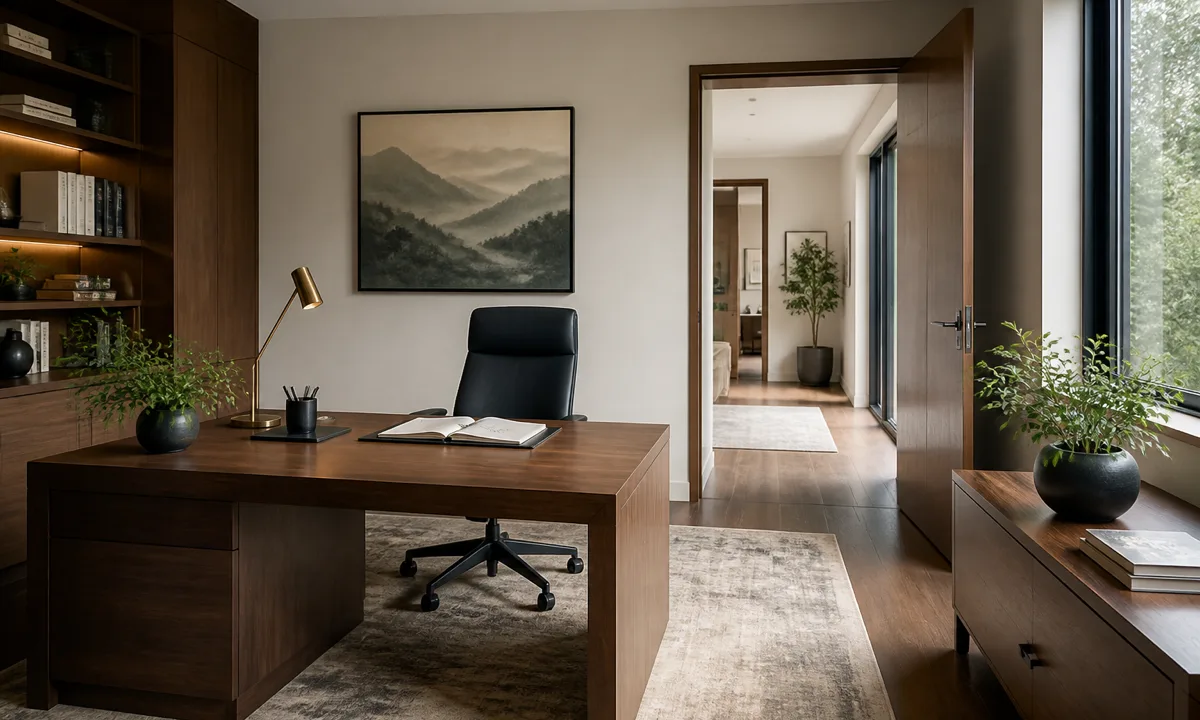
Your desk is where you spend a third of your waking life — and in feng shui, it is your command post. Get the placement right and work feels lighter; get it wrong and you are fighting the room all day.
These are the placement rules that matter most, in order of priority.
1. The commanding position
The single most important rule: sit where you can see the door without being in line with it.
| Placement | Effect |
|---|---|
| Desk diagonal to the door, facing into the room | Best — you see who enters, no one sneaks up on you |
| Desk directly facing the door | Okay — you see everything, but too much direct energy |
| Desk with your back to the door | Worst — hidden threats, restless energy all day |
| Desk in line with the door | Poor — the "arrow" energy hits your back or side |
If you cannot move the desk, add a mirror that shows the door from your seat — a practical fix used for centuries.
2. Solid wall behind you
A wall behind the chair gives you support ("mountain behind you" in feng shui). Avoid a window, a busy walkway, or a shelf of clutter directly behind your seat. If the space behind is a window, hang a panel or blind to create visual solidity.
3. Face a good direction
Your ideal facing direction depends on your favorable element — which a BaZi reading can tell you precisely. A simple rule that works for most people:
- If your work is creative, face east or southeast (wood energy supports growth).
- If your work is administrative or financial, face south (fire) or west (metal) — visibility and precision.
- When unsure, face the room's natural center of activity, not a blank wall.
4. Clear the space in front of you
What your eyes rest on, your mind follows. Keep the desk surface in front of you clear — one working item at a time. A wall of sticky notes and stacked papers directly ahead creates scattered attention.
5. Desk accessories that help
| Item | Purpose |
|---|---|
| Desk lamp on the opposite side of your writing hand | Even light, no shadow on your work |
| A small plant (bamboo, pothos) | Living energy, softens sharp corners |
| A water element (small fountain) | Calm flow — good for money and clarity |
| A family photo or meaningful object | Grounding, reminds you why you work |
Avoid: clutter, broken electronics, and piles of old papers — they anchor you to the past.
The desk placement checklist
| # | Check | Done |
|---|---|---|
| 1 | Can you see the door from your seat? | ☐ |
| 2 | Is your back to a solid wall? | ☐ |
| 3 | Is your back NOT to a window or walkway? | ☐ |
| 4 | Is the space in front of you clear? | ☐ |
| 5 | Is your desk free of clutter and broken items? | ☐ |
| 6 | Do you have a light source that does not shadow your work? | ☐ |
| 7 | Is there a living plant within sight? | ☐ |
---
Related reading
- Feng Shui home office layout — the full room guide
- Best Feng Shui tools 2026 — tested picks
- How to read a BaZi chart — find your favorable direction
- Feng Shui guide — the hub
Frequently Asked Questions
Which direction should my desk face?
The best direction depends on your favorable element. A practical default: face the room's activity rather than a wall, keep the door visible, and put a solid wall behind you. For a precise direction, a BaZi reading tells you your favorable element and facing.
Is it bad to face a wall when working?
Facing a wall directly is not ideal — your energy bounces off it and comes back at you, which can feel stifling. If you must face a wall, keep it clean and hang something calm and inspiring (a landscape, a quote) to soften the energy.
Where should the desk be in a bedroom?
Ideally outside the bedroom entirely. If it must be there, position it so you cannot see it from the bed, cover it at night, and keep work items out of sight — the bedroom should end the day, not extend it.
How can I improve my desk feng shui without moving anything?
Three quick fixes: clear the space directly in front of you, add a small plant or water element, and place a mirror so you can see the door if your back is to it. These three address the biggest energy leaks without a single piece of new furniture.