
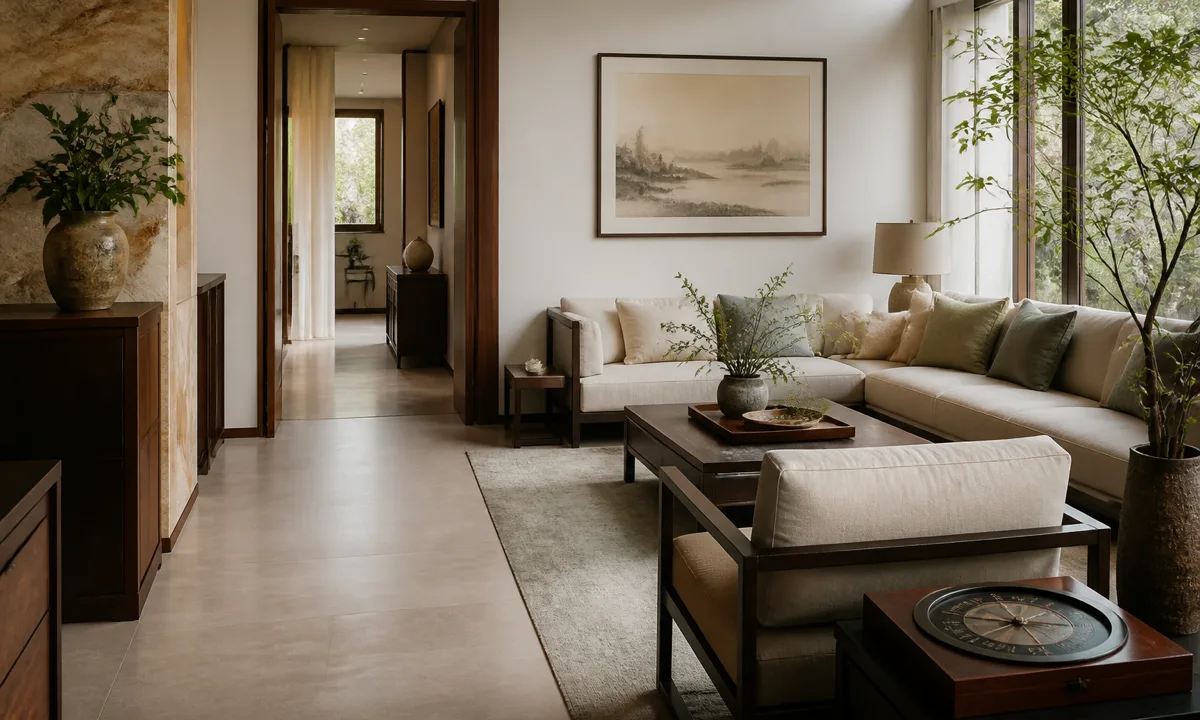
Quick answer: Feng Shui for a small apartment focuses on flow over furniture: keep the entrance clear, open pathways, lift energy with light and mirrors, and give every object a home. In a small space, decluttering IS the Feng Shui — blocked space means blocked qi, so the best "cures" are usually free: clear surfaces, brighter light, and one strong focal point.
---
Why small spaces need different Feng Shui
A big house can hide its problems; a small apartment shows everything. In Feng Shui terms, a compact home is more sensitive to every choice — a cluttered hallway, a blocked corner or a dark nook has an outsized effect. The good news: the same sensitivity means small adjustments work faster. You don't need a redesign; you need smart placement.
The 10 tips
- Clear the entrance first — the doorway is the mouth of qi. In a small apartment it's often cramped: remove shoes, coats and clutter from the entry zone.
- Open the main pathway — walk from the door to the most-used spot. Anything in that path (boxes, chairs, cables) is blocking qi.
- Declutter surfaces, not just floors — in small spaces, horizontal surfaces (shelves, countertops, tables) fill fast. One clear surface = one clear mind.
- Use mirrors strategically — a mirror can visually double a small room and bounce light. Place it to reflect light or a window, not the bed or door.
- Brighten every corner — dark corners feel stagnant. A small lamp, a mirror, or a light-colored object lifts the energy.
- Pick one focal point per room — in a small room, one strong element (a plant, a piece of art, a warm light) beats ten small objects.
- Create the "command position" — even in a studio, position your bed or desk to see the door, with a solid wall behind.
- Go vertical — use tall, slim shelves to store upward instead of outward; it keeps the floor clear and the eye moving.
- Choose light, multi-function furniture — a sofa bed, a foldable table, wall-mounted shelves reduce visual weight.
- Let in air and light daily — open windows every day. In a small space, fresh air is the simplest form of good qi.
The one-room (studio) special rules
A studio is one room doing many jobs. To keep it working:
- Divide without walls — use a rug, a curtain, or a shelf to separate "sleeping" and "living" zones
- Tuck the bed into the command position — see the door, solid wall behind
- Keep the bed clear of the kitchen line — if cooking and sleeping share a room, aim the bed away from the stove
- Let each zone have its own light — separate lamps help each area feel intentional
What to avoid in a small space
- Too much furniture — a small room with big furniture reads as crowded; scale pieces to the room
- Overflowing storage — visible clutter is amplified in small spaces
- Heavy dark walls — they visually shrink the room and feel heavy (see bedroom colors for calmer options)
- Blocked windows — windows are literal light and qi; keep them clear
A note on approach
Feng Shui in a small apartment is not about buying objects — it's about flow, light and order. Most of these tips are free and take five minutes. Start with the entrance and the main pathway, live with the change for a week, then go further if you want.
👉 See your element balance — knowing your Five Elements helps you choose which colors and materials feel most supportive in a compact space.
---
Related reading
- Feng Shui living room layout — arrange for flow
- Feng Shui for beginners — the 7 first steps
- Best Feng Shui bedroom colors — calm tones for compact rooms
- Feng Shui money corner — even a studio has one
- Feng Shui guide — the hub
Frequently Asked Questions
Is Feng Shui possible in a small apartment?
Yes — and it often works faster than in big houses. A small space is more sensitive to every change, so clearing the entrance, opening pathways and lifting light make an immediate difference.
What is the most important Feng Shui tip for a studio?
Clear the entrance and open the main pathway from the door. In a one-room home, blocked flow is the biggest issue — and it's free to fix.
Do I need to buy Feng Shui items for a small apartment?
No. Most effective small-space Feng Shui is free: decluttering, brightening corners, repositioning furniture. Objects come second to flow and light.