
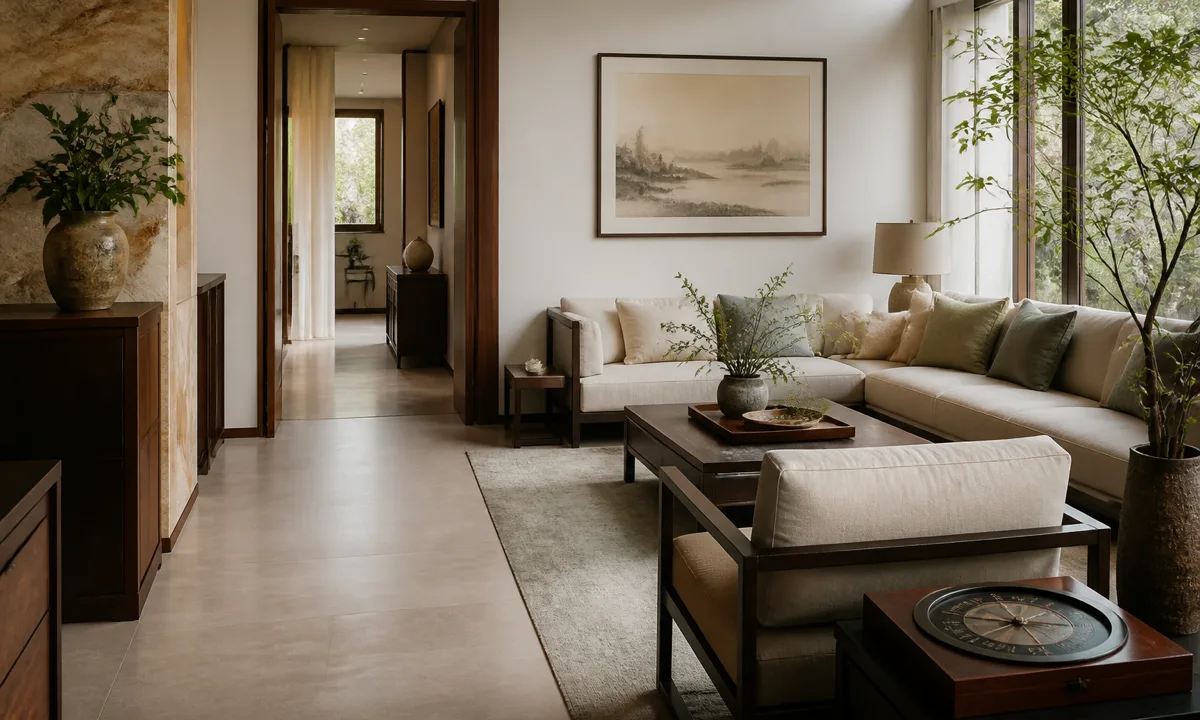
Quick answer: The best Feng Shui living room layout puts seating in a circle or L-shape facing each other (not against walls in a line), keeps the main pathway from the door clear, anchors the room with one focal point, and balances the five elements with light, plants, soft textiles and a few warm accents. The goal: a room where people naturally gather and talk.
---
The living room is the "bright hall"
In traditional Feng Shui, the living room is the Ming Tang (明堂, bright hall) — the space where qi gathers and where the family connects. Its job is to feel open, welcoming and alive. Everything below serves that one idea.
The 6 layout principles
- Seating faces each other — the most important rule. Chairs and sofas should face each other or form an L, not line up against walls facing a TV. Feng Shui reads this as: people face each other → connection happens.
- Clear the door-to-sofa pathway — the route from the entrance to the seating area should be open. No coffee table in the doorway, no boxes on the path.
- One focal point — a fireplace, a large window, a piece of art, or a feature plant. The room should have a clear "anchor" that draws attention.
- Solid support behind seating — sofas should have a wall (or a solid piece of furniture) behind them, not a window or an empty gap — the "command position" for the room.
- Balance the five elements — aim for a mix: a plant (Wood), warm lighting (Fire), soft neutral textiles (Earth), a metal or glass accent (Metal), and a dark or blue detail (Water). No single element dominating.
- Edge softness — sharp corners pointing at seating are "poison arrows" in Feng Shui. Soften with plants, rugs, or rounded furniture.
Colors for a living room
| Element | Colors | Living room use |
|---|---|---|
| Wood | Green, teal | Plants, a green armchair, cushions |
| Fire | Red, orange, warm | A lamp, an accent wall, art — sparingly |
| Earth | Beige, warm brown | Sofa, rug, wood tones — the safe base |
| Metal | White, gray, gold | Frames, a metal table, decor |
| Water | Deep blue, black | A throw, a vase, small accents |
Common mistakes
- TV as the focal point — if the TV dominates, balance it with art or a plant beside it, and keep seating arranged for conversation
- Sofa against a window — breaks the "solid back" rule; if unavoidable, add a low shelf or plant behind
- Everything against the walls — makes the room feel like a waiting room; pull seating inward into a circle
- Too dark or too busy — a living room needs light; balance dark walls with lamps and mirrors
A simple arrangement checklist
| Check | Good | Fix if... |
|---|---|---|
| Seating | Faces each other / L-shape | Rearrange into a circle |
| Pathway | Door → seating clear | Move the coffee table |
| Focal point | One clear anchor | Add art or a feature plant |
| Support | Wall behind sofa | Add shelf/plant behind |
| Five elements | 3+ elements present | Add plant / lamp / textile |
| Light | Bright, warm, layered | Add lamps, mirrors |
👉 See your element balance — your chart suggests which elements your living room could use more of.
---
Related reading
- Feng Shui for small apartments — space-smart tips
- Feng Shui for beginners — the 7 first steps
- Feng Shui bedroom rules — rest rules
- Feng Shui guide — the hub
Frequently Asked Questions
Where should a sofa be placed in Feng Shui?
The sofa should have solid support behind it (a wall, not a window) and face the room — ideally forming an L or circle with other seating so people face each other. It should also see the door without being directly in line with it.
Is it bad to have the TV as the focal point?
It's not ideal. A TV dominates energy and pulls attention away from connection. Balance it with art, a plant or a warm light beside it, and arrange seating for conversation rather than screen-watching.
What color is best for a living room in Feng Shui?
Earthy tones (beige, warm brown) make the safest base; add greens (Wood) for freshness, warm accents (Fire) sparingly, and a blue or dark detail (Water) for depth. Balance beats any single color.