
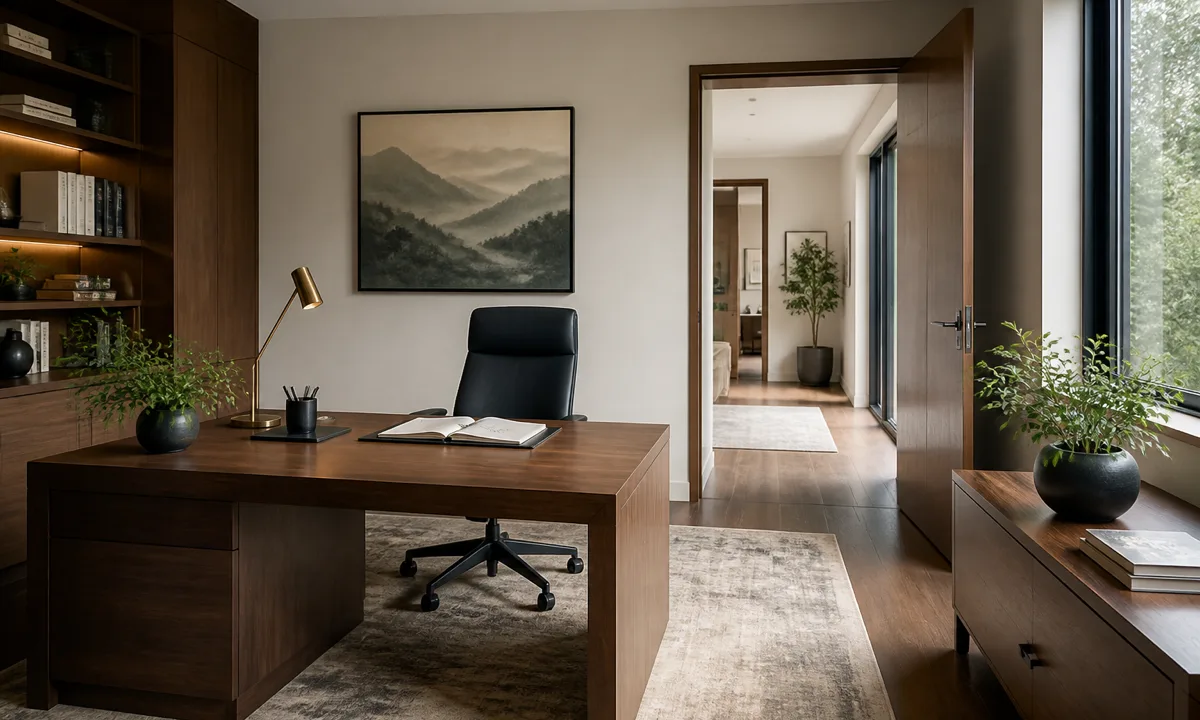
A feng shui desk placement checker tells you which direction to face or avoid — but like any tool, it has a boundary. It can calculate directions and favorable elements; it cannot see your room, your door, or your actual situation. This guide separates what these tools genuinely do from what they cannot.
What a desk placement checker can tell you
| Can do | How it works |
|---|---|
| Your favorable facing direction | From your birth data (favorable element → direction) |
| Directions to favor or avoid | Traditional feng shui mapping of elements to compass points |
| Personal timing (advanced) | Annual flying stars or yearly directions |
A checker is essentially a calculator: input your data, get directional guidance based on the method it uses (BaZi element, Kua number, or annual stars).
What it cannot tell you
| Cannot do | Why |
|---|---|
| See your room layout | It has no camera or floor plan |
| Judge your actual desk position | It does not know where your door, window or desk are |
| Account for real obstacles | Columns, beams, clutter are invisible to it |
| Replace a site review | A real assessment needs the physical space |
A direction is useful only when applied to your actual room — the checker gives the target, you (or a practitioner) do the placement.
The two questions a checker answers
- Which direction suits me? — from your favorable element or Kua number.
- Where should the desk go? — needs your room: see the door, avoid your back to it, solid wall behind.
The first is calculable; the second is spatial. A good workflow: use the checker for direction, then apply the classic placement rules to your room.
Practical desk placement rules that always apply
Whatever your favorable direction:
- See the door from your seat without being in line with it.
- Solid wall behind you (not a window or walkway).
- Clear space in front — what your eyes rest on, your mind follows.
- No clutter on or around the desk.
These four are universal — they work regardless of which direction the checker suggests.
---
Related reading
- Feng Shui hub — the pillar guide
- Feng Shui desk placement
- Home office layout
- Kua number vs desk
Frequently Asked Questions
Is a feng shui desk placement checker accurate?
It is accurate at calculating the direction its method targets (your favorable element or Kua number). It cannot measure your room — direction guidance is only one input. The placement itself still depends on your actual space.
What does a desk placement checker need from me?
Usually your birth data (year, and often month/day/time for a precise favorable element) or your Kua number. Some tools use only the current year for annual directions. Check what input the tool asks for before trusting its output.
How do I find my favorable desk direction?
Your favorable direction comes from your favorable element (from a BaZi chart) or your Kua number (from birth year + gender). Tools can compute it, but the interpretation — which direction fits your work and life — benefits from understanding the method.
Can a checker replace a real feng shui review?
No. A checker is a calculator; a real review considers your room, door, windows, desk position and life context. Use the checker for direction, and apply room-level rules (or a practitioner visit) for placement.