
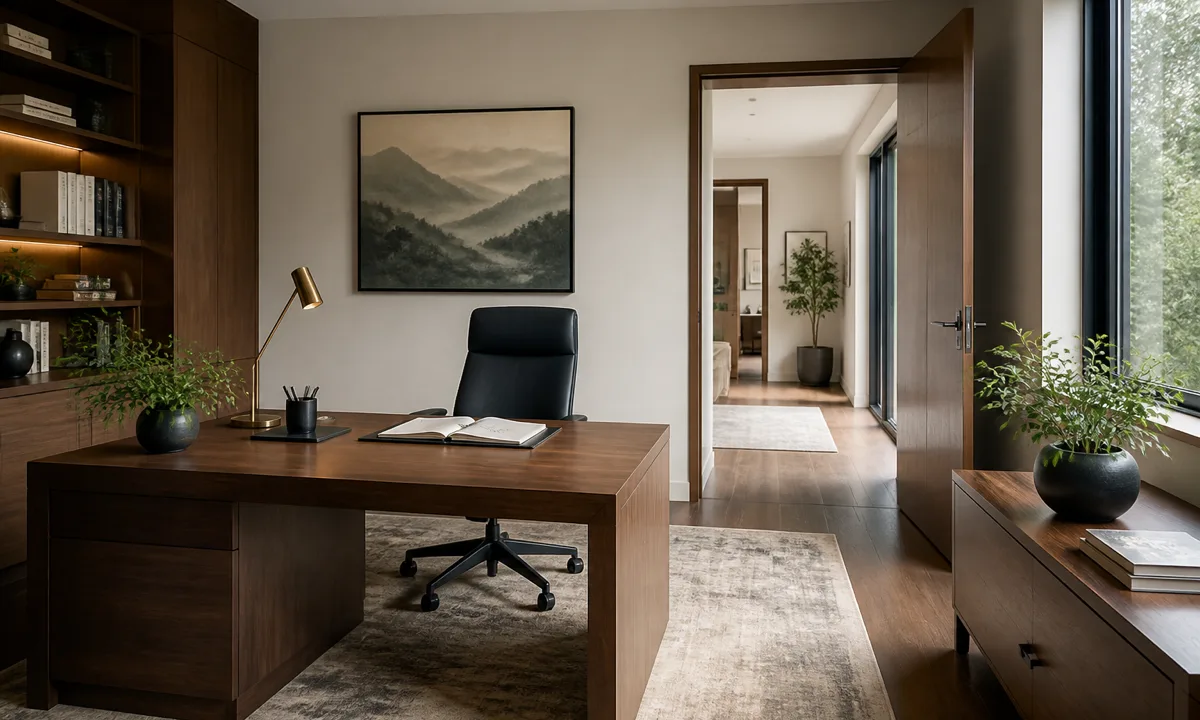
Two feng shui tools often get confused: the Kua number (from the Eight Mansions / Ba Zhai school) and desk placement rules (from the commanding-position tradition). They answer different questions. Here is what each does, when to use it, and how they combine.
The two tools at a glance
| Kua number | Desk placement | |
|---|---|---|
| School | Eight Mansions (Ba Zhai) | Practical placement |
| Input | Birth year + gender | Your room layout |
| Output | Personal lucky directions | Where to put the desk |
| Best for | Choosing direction to face | Positioning within a room |
What the Kua number does
The Kua number divides people into East-group and West-group, each with favorable and unfavorable directions.
How to calculate yours (traditional formula):
- Male: (100 − last two digits of birth year) ÷ 9, use the remainder
- Female: (last two digits − 4) ÷ 9, use the remainder
- Remainder maps to a trigram: 1 Kan, 2 Kun, 3 Zhen, 4 Xun, 5 (male Kun / female Gen), 6 Qian, 7 Dui, 8 Gen, 9 Li, 0 → 9
Example: a man born in 1990 → (100 − 90) ÷ 9 = 10 ÷ 9, remainder 1 → Kua 1 (Kan), East-group. His favorable directions include South (Li) and East (Zhen).
The Kua number tells you which direction to face — e.g., face a favorable direction when working or sleeping.
What desk placement does
Desk placement is spatial: where the desk sits within your room based on:
- Seeing the door (commanding position)
- Solid wall behind
- Not in line with the door
- Clear space in front
It does not need your birth data — it needs your room.
Which should you use?
| Scenario | Use |
|---|---|
| "Which direction should I face?" | Kua number |
| "Where do I put my desk in this room?" | Desk placement |
| Both — full guidance | Combine: face a favorable direction from a commanding position |
| Annual adjustments | Flying stars (a third layer) |
How they combine
The ideal setup satisfies both:
- Kua gives the direction — the compass point that suits you.
- Placement gives the position — a spot where you see the door with a wall behind.
- Combine — if your desk can face your favorable direction from the commanding position, that's the strongest arrangement.
If they conflict (the favorable direction has no wall behind), prioritize the room-level rules — the commanding position matters more than a compass point.
---
Related reading
- Feng Shui hub — the pillar guide
- Desk placement checker
- Lucky directions
- Desk placement rules
Frequently Asked Questions
What is my Kua number?
Your Kua number comes from your birth year and gender: male (100 − year last two digits) ÷ 9; female (year last two digits − 4) ÷ 9. The remainder maps to a trigram (1 Kan, 2 Kun...). It places you in the East or West group, each with favorable directions.
Is Kua number the same as desk placement?
No. Kua number is a birth-data tool that gives your personal lucky directions. Desk placement is a spatial tool for positioning your desk within a room. They complement each other: direction from Kua, position from placement.
Which feng shui direction method is best?
No single method is "best" — Kua gives personal directions, flying stars give annual directions, and placement rules handle the room. For desk setup, start with placement rules (see the door, wall behind), then apply your Kua direction if the room allows.
Do I need my birth time for Kua number?
No — Kua number uses your birth year and gender only. If you want a more detailed direction based on your full chart, a BaZi reading adds depth, but Kua works with year + gender.