
Quick Answer
Zodiac compatibility rests on three fixed relationships between the twelve Earthly Branches: San He (three-animal trios that support each other), Liu He (six animal pairs that bind) and clashes (six opposing pairs). Most compatibility charts reduce these to a tick or a cross — but the relationships describe structural interaction, not whether a relationship will succeed.
This article explains a traditional framework for cultural understanding. It does not predict relationship outcomes, and it is not relationship or counselling advice.
---
1. Where compatibility charts come from
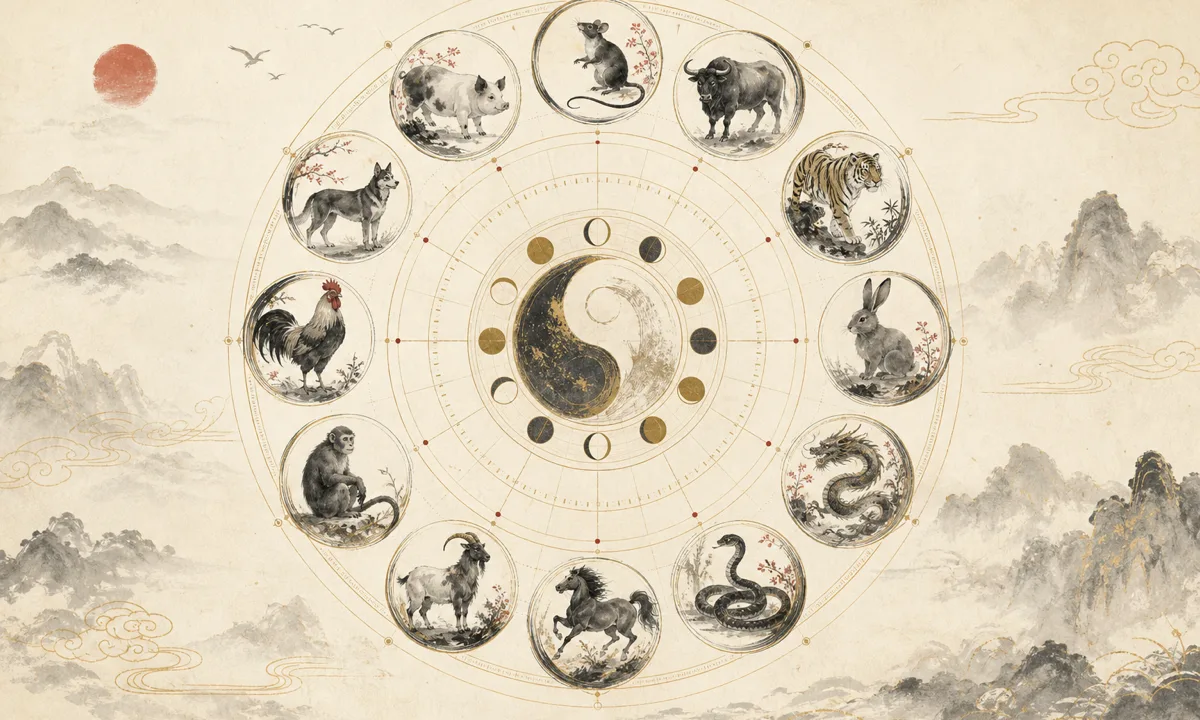
The familiar "which animal are you compatible with" table is a simplification of something more precise. Every animal sign corresponds to one of the twelve Earthly Branches, and those branches have fixed relationships with each other — the same relationships used across the whole system.
Compatibility charts take those relationships and apply them to the birth-year branch only. That is why they are quick to use, and also why they are limited: a full reading uses all four pillars, not just the year. The limitation is worth understanding before trusting any chart.
There are three relationships that matter for compatibility:
- San He (三合) — trios that combine into a strong element
- Liu He (六合) — pairs that bind
- Chong (冲) — pairs that oppose
2. The three relationships
| Type | Branches | Traditional reading |
|---|---|---|
| San He trio — Water | 申 子 辰 (Monkey, Rat, Dragon) | Mutual support; a group that reinforces |
| San He trio — Wood | 亥 卯 未 (Pig, Rabbit, Goat) | As above |
| San He trio — Fire | 寅 午 戌 (Tiger, Horse, Dog) | As above |
| San He trio — Metal | 巳 酉 丑 (Snake, Rooster, Ox) | As above |
| Liu He pair | 子丑 · 寅亥 · 卯戌 · 辰酉 · 巳申 · 午未 | Binding; mutual attraction |
| Clash | 子午 · 丑未 · 寅申 · 卯酉 · 辰戌 · 巳亥 | Tension; change; activation |
Read the table by asking what kind of interaction each row describes — not which one is "good".
San He is read as complementary support. The three animals in a trio are understood to reinforce each other because together they produce one dominant element. Two out of three still counts, as a weaker version.
Liu He is read as binding attraction. Pairs that combine are understood to act on each other rather than independently — often described as a natural pull.
Clash is read as tension and change. Opposing branches disturb each other. This is the one most often flagged in compatibility charts as a negative, and the one most often over-read.
3. Why a clash is not a verdict
This is the single most important correction to make about zodiac compatibility.
A clash indicates interaction, not incompatibility. In traditional reading it describes where two structures are in tension — which can mean friction, but can equally mean change, movement and a relationship that does not settle into routine.
Three specific cautions:
A clash between animal signs is not a prediction about two people. It describes the relationship between two branches, one of which is only the birth year. Two people are much more than their year branches.
Most "incompatible" pairs also share a supporting relationship somewhere else. Because each animal sits inside a trio, a "clashing" pair often has another branch in common that binds them. Compatibility charts usually show only the clash, which is a presentation choice rather than a complete reading.
The year branch is the least personal part of a chart. It describes the environment of a birth year, not the person. Reading compatibility from it alone is coarse by design.
For the underlying mechanism — the same branches, in more depth — see earthly branch clashes and combinations.
4. What a fuller reading looks at
If you want something more than a chart lookup, the traditional method moves up in layers:
The day pillar is the more personal reference. In the classical approach to matching two people, the day branch and the Day Master carry more weight than the year, because they describe the individuals rather than the era.
The interaction between two charts is read by comparing branches across both — looking for combinations and clashes between the two sets, not just within each one. This is considerably more involved than a compatibility table.
The rest of the chart — element balance, season, Ten Gods — informs whether a given interaction is helpful or burdensome. The same clash reads differently depending on what each chart needs.
How that compares to the zodiac-only approach is covered in zodiac compatibility vs BaZi compatibility.
5. How to use a compatibility chart sensibly
Three practical rules:
- Treat it as a conversation starter, not a conclusion. A chart can suggest which themes two people might notice — not whether they are suited.
- Look at what the chart omits. San He and Liu He are often shown; partial trios and secondary combinations usually are not. An incomplete table produces an incomplete picture.
- Never let a chart overrule your own experience. If a chart says a pairing is difficult and the relationship is good, the chart is describing a structural relationship between two symbols — not two people.
A traditional framework is a vocabulary for reflection. Applied to real relationships, it should open questions rather than close them.
6. Common questions about zodiac compatibility
Are clashing signs really incompatible?
No. A clash describes tension and interaction between two branches. It is not a prediction about two people, and the year branch alone is a thin basis for any conclusion.
Which pairing is the most compatible?
There is no single best pair. San He trios and Liu He pairs are read as supportive, but the classical method weighs the day pillar and the full chart — a compatibility table cannot rank real relationships.
Why do different charts give different answers?
Because they use different relationships, different weightings, or include different numbers of branches. A chart based only on clashes will disagree with one that also counts combinations.
Does my zodiac element matter for compatibility?
It adds a layer — element relationships can support or oppose. But it is still a year-level reading. See zodiac elements and compatibility for that layer.
Can I check compatibility without birth times?
You can get a year-level reading, which is what most charts give. A fuller traditional reading uses the day pillar, and that needs at least a birth date.
---
CTA: See the branch relationships in a full chart
---