

Quick Answer
Yes, in the traditional framework — but with an important limit. Each zodiac year carries one of the five elements, and element relationships (producing, controlling) can be read as supporting or opposing between two signs. However, that element belongs to the year, not the person, so it is a coarse layer compared with reading the Day Master.
This article describes a traditional cultural framework. It does not predict relationship outcomes and is not relationship advice.
---
1. Where a zodiac element comes from
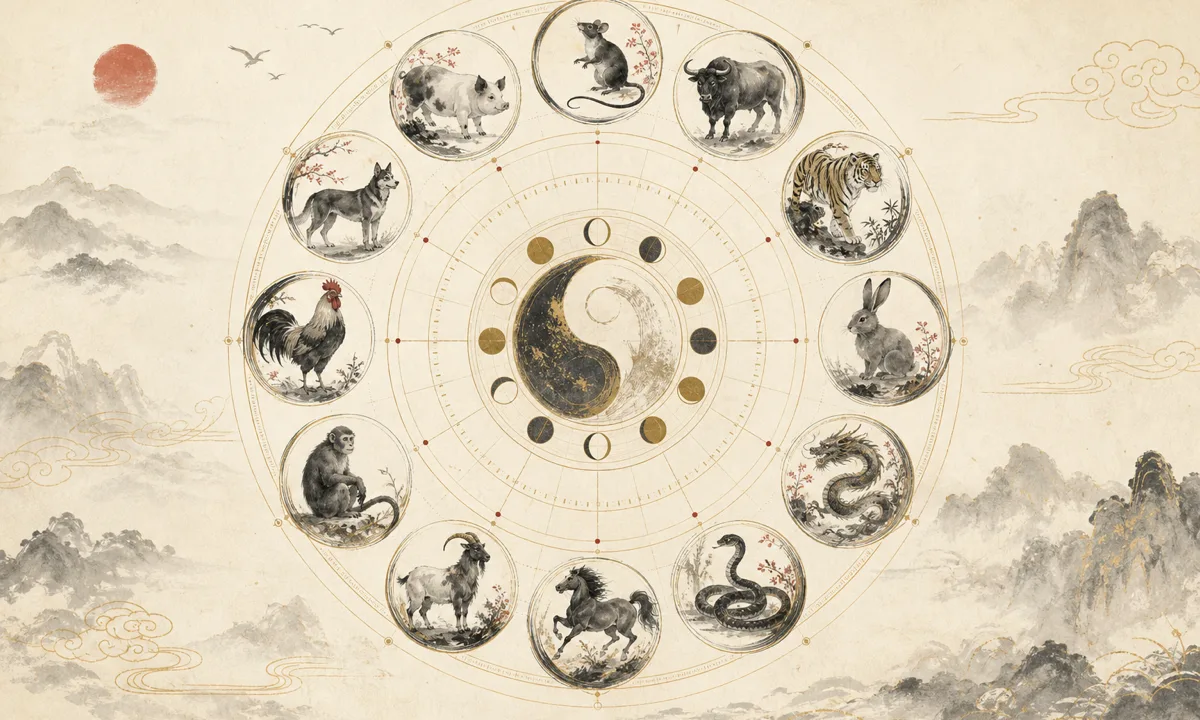
An animal sign alone repeats every twelve years. The element is what makes each cycle distinct: the two cycles combine into a sixty-year sequence, so a Fire Horse and a Water Horse are different years even though both are Horses.
The pairing runs in a fixed order — each animal appears once with each element across the sixty years. This is why "your element" as commonly described is your birth-year element, and why the same animal sign can produce different element pairings depending on the year.
Two clarifications before using this in compatibility:
The zodiac element is a year marker. It describes the character of a birth year in the traditional cycle, not the individual. Personal element, in the fuller system, comes from the Day Master.
It is one of five, cycling. There is no element that is inherently compatible or incompatible — relationships between elements are directional, and the reading depends on which direction you are looking.
2. How element relationships are read
The five elements interact in two directions: producing (one generates the next) and controlling (one restrains another). Traditional compatibility readings use these to describe how two signs relate.
| Relationship | Example | Traditional reading |
|---|---|---|
| Same element | Wood + Wood | Reinforcement; similar tendencies |
| Producing (A → B) | Wood → Fire | Support flowing one way |
| Produced by (B ← A) | Fire ← Wood | Receiving support |
| Controlling (A → restrains B) | Wood restrains Earth | Friction; one constrains the other |
| Controlled by | Earth controlled by Wood | Being constrained |
Three things to notice about this table.
Neither direction is simply good or bad. "Producing" is generally read as supportive, but constant support with no return can be described as one-sided. "Controlling" is read as friction — which in a working relationship is not the same as failure.
Direction matters. Wood producing Fire is read differently from Fire producing Wood. Compatibility charts that flatten this into "compatible / incompatible" lose the distinction.
Same element is not automatically ideal. Two of the same element reinforce each other's qualities, which can mean agreement — or can mean the same weakness doubled.
For the elements themselves, see the five elements. For how animal signs map to elements, see zodiac elements.
3. Combining element with animal relationships
In practice, most traditional compatibility readings combine two layers:
- The branch relationship between the two animal signs — San He trios, Liu He pairs, clashes. Covered in zodiac compatibility: San He, Liu He and clashes.
- The element relationship between the two birth-year elements.
The two can agree or disagree. A pair might clash by branch while their elements produce each other — which is exactly the kind of case a single-letter chart cannot express. Traditional reading treats this as mixed, not as a contradiction to resolve.
That is also why different charts disagree: one may weight the branch relationship, another the element, and a third may count only clashes.
4. Why a year-level element is coarse
This is the most important limit in the article.
Your birth-year element is not your element. It is the element attached to that year in the cycle. In the fuller system, the personal reference is the Day Master — the stem of your day pillar — which can be entirely different from your year element. Two people born in the same year share a year element and can have completely different Day Masters.
A year element describes a cohort, not a person. Reading compatibility from two year elements is reading the relationship between two birth years.
The animal sign alone already discards most of the chart. Adding the year element adds a layer, but it is still the year layer — the part of the chart that traditional reading weighs least for personal questions.
None of this makes the method useless. It makes it what it is: a coarse, culturally meaningful shorthand. Used as a conversation starter it is fine. Used to judge a relationship it exceeds what the framework can support.
If you want the comparison laid out, see zodiac compatibility vs BaZi compatibility.
5. How to use it without over-reading
Three practical rules:
- Treat a "clash" between elements as a theme, not a forecast. It suggests where friction might show up — not whether it will be fatal.
- Look at both layers before concluding. Branch relationship and element relationship together give a mixed picture far more often than a chart implies.
- Remember what is missing. Day pillars, the rest of both charts, and the people themselves are all absent from a year-level reading.
A traditional framework is a vocabulary. Applied to real relationships, it should raise questions worth asking rather than deliver a verdict.
A practical test for any tool. If a compatibility tool produces a percentage without asking for either person's birth time, it is working entirely from birth years — which means the number reflects its own formula, not the two people. That is worth knowing before you give the number any weight.
6. Common questions about zodiac elements and compatibility
Does my zodiac element matter for compatibility?
It adds a traditional layer, read through producing and controlling relationships. It is still a year-level marker, so treat it as a coarse indicator rather than a personal one.
Which element pairs are most compatible?
None are universally so. Producing relationships are read as supportive and controlling ones as friction, but direction and context change the reading — and same-element pairs are not automatically ideal.
Is my zodiac element the same as my BaZi element?
Usually not. The zodiac element is attached to the birth year; your personal reference in BaZi is the Day Master, which frequently differs entirely.
Why do zodiac compatibility charts contradict each other?
Because they combine the layers differently — some use clashes only, some include combinations, some weight elements. A chart's answer reflects its method, not a single truth.
Can zodiac elements predict whether a relationship works?
No. The method describes relationships between two birth years. It carries no predictive content about two people, and it should not be used to make decisions about a relationship.
---
CTA: Compare your year element with your actual Day Master
---