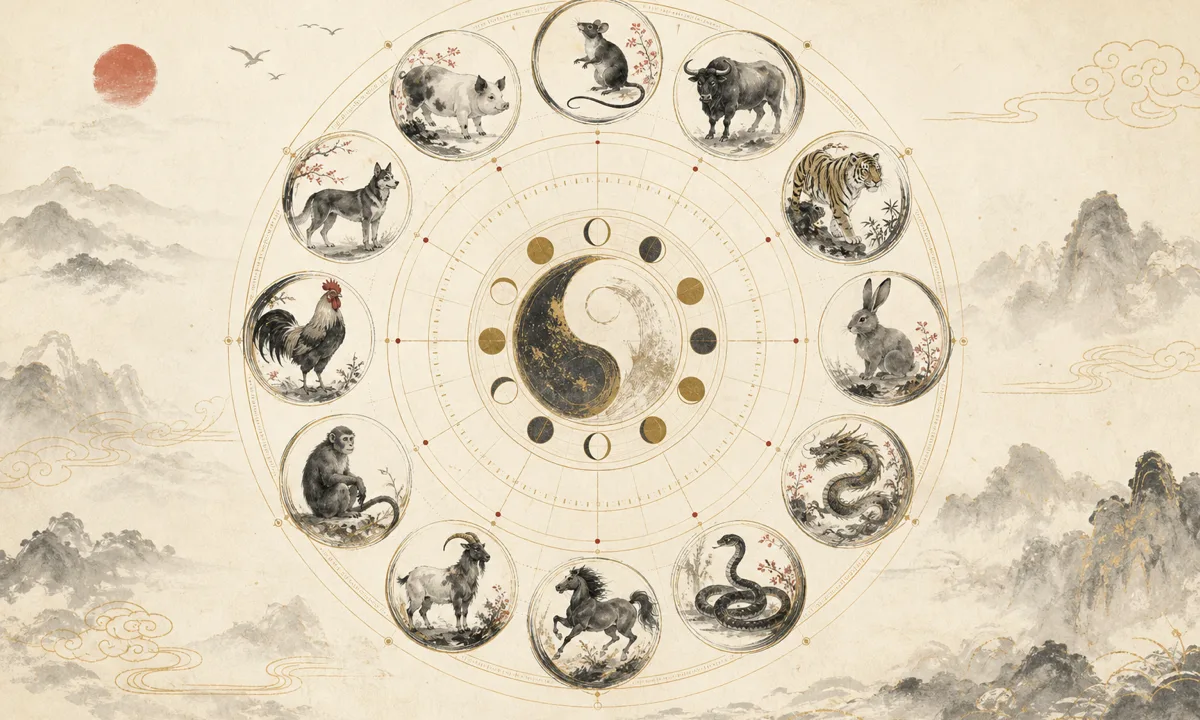
Chinese zodiac compatibility reads how two people's Earthly Branches interact — it can describe patterns, not predict outcomes. The Earthly Branches of the twelve zodiac animals form a circle, and the way two branches sit on that circle tells you whether they support, complement, or face each other directly. That geometry is what makes zodiac compatibility a useful starting point — and also where its limits begin.
Quick answer
Chinese zodiac compatibility reads the Earthly Branches of two birth years — the twelve positions that sit behind the twelve animals. When two branches fuse into a single element, the pair has natural ease (Six Harmony). When they face each other across the circle, the pair tends toward friction (Six Clash). The system describes how two yearly energies interact, not whether a relationship will work.
Key terms, defined
| Term | What it means |
|---|---|
| Earthly Branch | One of twelve energy positions (Zi, Chou, Yin, Mao, Chen, Si, Wu, Wei, Shen, You, Xu, Hai) that carry each zodiac animal |
| Six Harmony | Two branches that merge into one element — deep natural fit |
| Three Harmony | Three branches that form a complete element group — friendship and team chemistry |
| Six Clash | Two branches facing each other across the circle — dynamic, but friction-heavy |
| Six Harm | Branches in awkward positions — small repeated irritations |
| Element overlay | Each branch carries one of the five elements (Wood, Fire, Earth, Metal, Water); same-element pairs add a layer of similarity |
A practical way to hold the framework: compatibility is a vocabulary for relationship patterns, not a forecast of whether two people will work out.
What zodiac compatibility CAN tell you
Three honest uses:
- A shared vocabulary for early conversations. Naming the harmony or clash pair gives a couple a neutral way to talk about their natural rhythm. "We are a clash pair" is useful information, not a verdict.
- A pattern check over time. If two people consistently trip on the same friction, the Six Clash and Six Harm framework helps describe why — and what to name it.
- A first-pass filter for group dynamics. Three Harmony groups (Water: Rat/Dragon/Monkey, Fire: Tiger/Horse/Dog, Metal: Snake/Rooster/Ox, Wood: Rabbit/Goat/Pig) explain why some friend circles click faster than others.
For each "can," there is a paired "cannot." Use the framework as a lens, not a verdict.
What zodiac compatibility CANNOT tell you
| It cannot | Why |
|---|---|
| Whether a relationship will succeed | Compatibility describes patterns; outcomes depend on communication, timing, and individual growth |
| Diagnose a partner's personality | Millions of people share the same animal; the branch is one of dozens of personality lenses |
| Replace a deeper reading | BaZi (Four Pillars) reads full birth data — day, hour, season — which is far more personal |
| Predict timing of meeting or breaking up | The framework is timeless; it does not have a calendar built in |
| Stand above shared life experience | A long-married clash pair with good communication will outlast a brand-new harmony pair with none |
A practical two-step way to use it
Step 1 — Find your pair's standing on the circle
| Your pair's pattern | What it suggests |
|---|---|
| Six Harmony | Natural ease in the early phase; watch that ease doesn't replace effort |
| Three Harmony (same group) | Easy teamwork; expect fast understanding in groups |
| Six Clash | Different rhythms; schedule check-ins rather than assume alignment |
| Six Harm | Small repeated friction; name the pattern, then talk about it |
The full table lives in the Chinese Zodiac Compatibility Guide and the compatibility chart — start there if you want the complete picture.
Step 2 — Layer in the elements
Each branch carries an element. Same-element branches add a layer of natural similarity; opposing elements add creative tension. The element overlay is the simplest second step beyond the animal — and it points you toward the deeper BaZi reading if you want to go further.
When to use which tool
| Your question | Use |
|---|---|
| "What is our compatibility at a glance?" | Zodiac compatibility (this page) |
| "What is the full compatibility picture?" | The Chinese Zodiac Compatibility Guide |
| "How does our chart interact?" | BaZi reading — see the free BaZi calculator for both charts |
| "What does the year ahead look like?" | The Chinese Zodiac overview plus a 2026 outlook |
Frequently Asked Questions
Can zodiac compatibility predict if two people will be happy together?
No. The framework reads how two yearly energies interact — it is a pattern language, not a forecast. Many long, happy marriages exist between clash signs; many short ones exist between harmony pairs. Use it as a conversation starter, not a verdict.
Is Chinese zodiac compatibility the same as BaZi compatibility?
No. Zodiac compatibility works with the birth-year branch alone — twelve possibilities. BaZi (Four Pillars) reads the full birth data: year, month, day, hour, plus hidden stems. BaZi is more personal and detailed, and is what most practitioners use for serious compatibility work.
Which animal pairs are considered the worst match?
The traditional "needs care" list is the Six Clash pairs: Rat–Horse, Ox–Goat, Tiger–Monkey, Rabbit–Rooster, Dragon–Dog, Snake–Pig. These pairs face different life rhythms and tend to argue about direction — not a verdict, but a signal to communicate deliberately.
Should I trust a free online compatibility calculator?
A free calculator is fine for a first pass — it will tell you the Six Harmony, Three Harmony, and Six Clash standing, which is most of the framework. For deeper, more personal work, look at the full BaZi chart of both people rather than the birth year alone.
Where can I find my Chinese zodiac sign and element?
Your zodiac sign comes from your birth year on the Chinese lunar calendar; check the Chinese Zodiac overview for the cycle. The element on top of your sign (Wood Rabbit, Fire Horse, etc.) layers in — both are starting points, not definitions.