
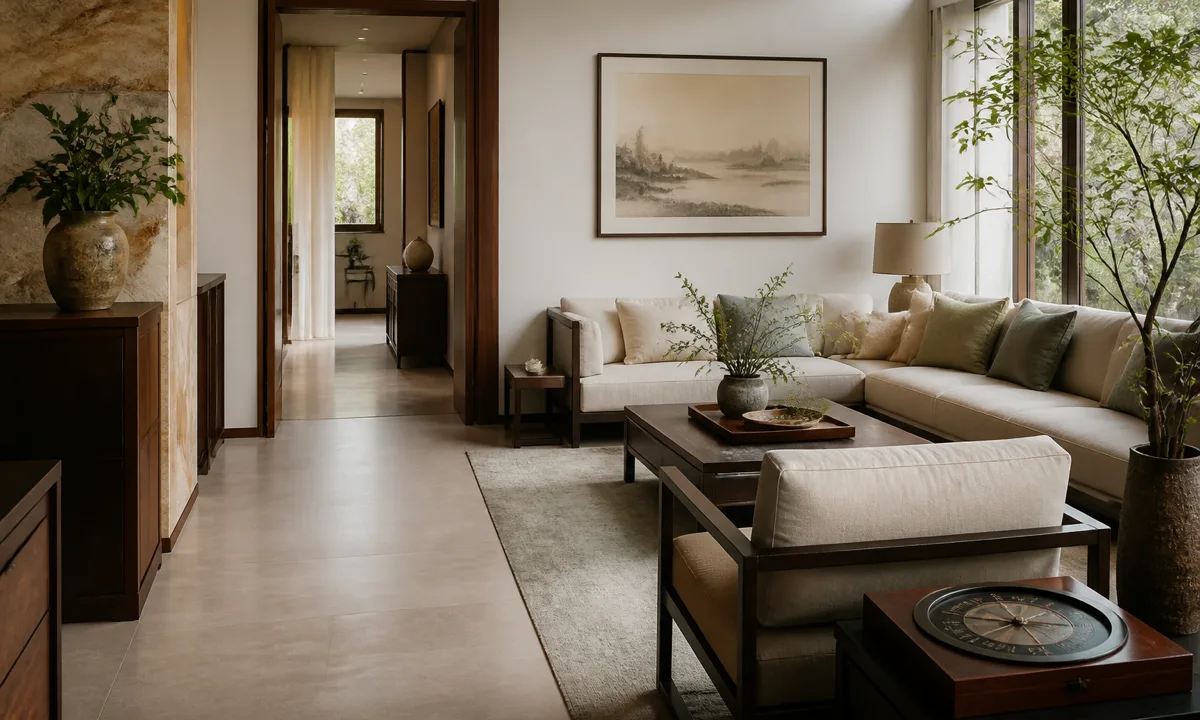
Quick answer: Feng Shui (风水, "wind and water") is a Chinese practice of arranging your physical space so that energy — called qi — flows well. The core idea: your environment shapes your energy, and small adjustments to layout, light and objects can make a space feel more calm, clear and supportive. It is a framework for intentional living, not magic.
---
Where the name comes from
Feng Shui literally means "wind and water." The phrase comes from an ancient text, the Zang Shu (Book of Burial): qi scatters when it meets wind, and stops when it meets water. Wind and water were seen as the two forces that move or gather energy in a landscape. Over centuries, that idea grew into a full system for reading and arranging space — from mountains and rivers down to a single room.
The three core ideas
1. Qi — the energy of a place
Qi is the subtle energy that flows through everything. In Feng Shui the goal is simple: qi should flow smoothly, gather gently, and not rush or stagnate. A cluttered hallway that blocks movement, or a desk shoved into a dark corner, are both examples of qi that isn't moving well.
2. Yin and Yang — balance
Yin (quiet, dark, soft, still) and Yang (bright, active, warm, moving) are two halves of a whole. A room with harsh lights and noise everywhere is too Yang; a room that is always dark and cold is too Yin. Good Feng Shui aims for a comfortable balance between the two.
3. The Five Elements — a language of qualities
Wood, Fire, Earth, Metal and Water describe qualities in a space. A plant brings Wood (growth); a candle brings Fire (warmth); a ceramic bowl brings Earth (stability); a metal lamp brings Metal (clarity); a mirror or fountain brings Water (flow). The five elements interact — some support each other, some balance each other — which is how practitioners think about what to add, remove or adjust.
How a room is "read"
| Principle | What it means | Beginner example |
|---|---|---|
| Clear flow | Pathways and doorways should be unblocked | Don't stack boxes in the hallway |
| Command position | The main seat/desk should face the door, not be stabbed by it | Desk diagonal to the door, not with back to it |
| Balance | Light/dark, full/empty should be balanced | Add a lamp to a dark corner, clear a crowded shelf |
| Five elements | Every space needs a mix of qualities | A plant + a warm light + a soft rug |
| Intentional objects | What you display affects the feel | Keep photos/objects that support how you want to feel |
Common beginner mistakes
- Treating it as superstition — Feng Shui is a design-and-intention framework; the "rules" are mostly about flow, light, order and comfort
- Buying everything red — adding every "lucky" item at once creates clutter, which is the opposite of good qi
- Ignoring the practical — a beautiful Feng Shui arrangement that blocks your wifi or tripping hazard is bad Feng Shui
- Forgetting the door — the entrance is the "mouth of qi"; it should be clean, bright and welcoming
Easy first steps (5 minutes each)
- Clear the entrance — your front door and entryway should be clean and unobstructed
- Fix the command position — if your bed or desk is in a blind spot, move it to see the door
- Balance your desk — add one plant and one warm light source
- Declutter one surface — the desk, a shelf, or the kitchen counter
- Open the windows — fresh air and light are the most literal form of good qi
Is Feng Shui religious?
No. Feng Shui is a traditional framework for space and intention, not a religion. Many people use it as a practical design language — like a more holistic version of interior design — regardless of their beliefs. (See our Feng Shui vs religion discussion for more.)
👉 See your personal energy balance — your birth chart shows which Five Elements are strong for you, which makes Feng Shui adjustments far more personal.
---
Related reading
- Five Elements explained — the pillar guide
Is Feng Shui a religion?
No. Feng Shui is a traditional Chinese framework for arranging space and intention. It is commonly used as a practical design language and is compatible with any belief system.
Does Feng Shui really work?
Feng Shui works the way good interior design works: a calm, well-lit, uncluttered space genuinely affects mood and focus. The "effects" are best understood as supportive environment changes, not guaranteed outcomes.
Can I Feng Shui my home without buying anything?
Yes. The most effective Feng Shui starts free: clearing clutter, improving light and air, and repositioning furniture. Objects are secondary to flow and order.
What is the first thing to do for Feng Shui?
Clear and brighten your entrance. The front door is considered the mouth of qi — a clean, welcoming entry sets the tone for the whole home.