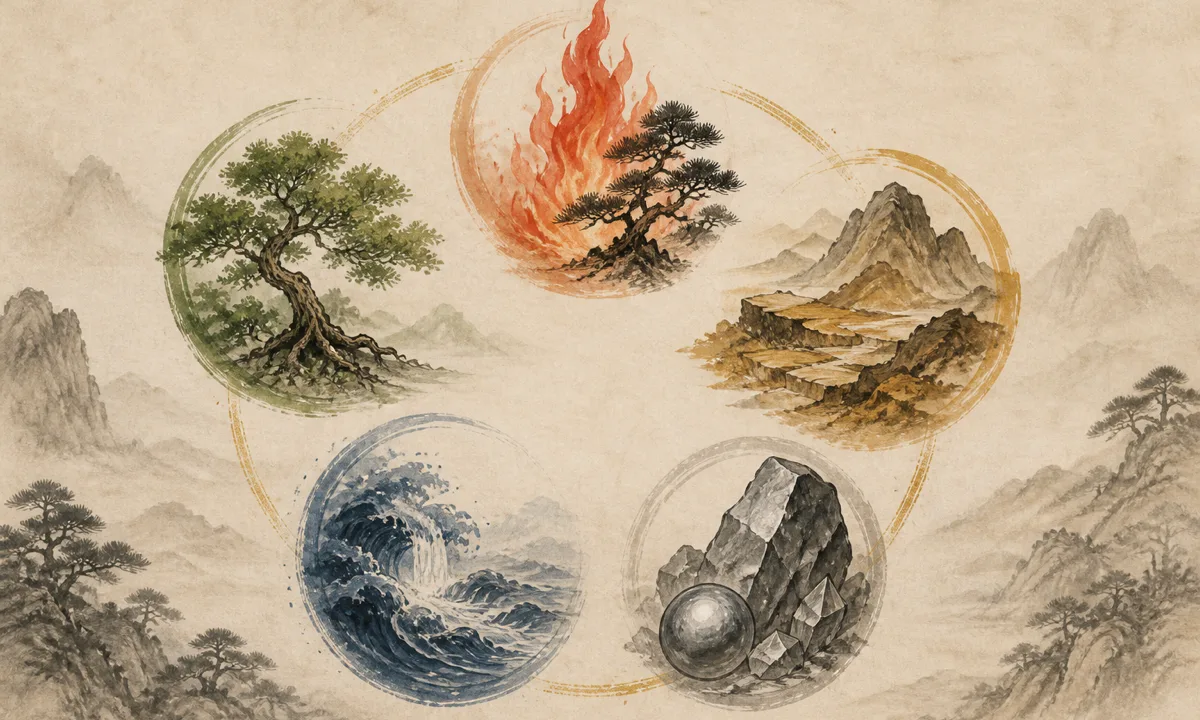
Quick answer: The Five Elements (五行, wǔ xíng) are Wood, Fire, Earth, Metal and Water — five fundamental energies in Chinese philosophy used to describe how the world moves and changes. They are not five materials; they are five processes: growth (Wood), expansion (Fire), stability (Earth), contraction (Metal) and flow (Water). Everything — seasons, colors, organs, personalities, even time — can be mapped onto them.
---
The five elements, decoded
| Element | Process | Season | Direction | Color | Classic image |
|---|---|---|---|---|---|
| Wood 木 | Growth, upward | Spring | East | Green | A tree reaching toward light |
| Fire 火 | Expansion, warmth | Summer | South | Red | A flame rising and radiating |
| Earth 土 | Stability, harvest | Late summer | Center | Yellow | Soil that holds everything |
| Metal 金 | Contraction, clarity | Autumn | West | White | A blade that cuts cleanly |
| Water 水 | Flow, depth | Winter | North | Black/Blue | A river finding its own way |
How the elements relate: two cycles
The system is built on two relationships — and this is where it gets genuinely useful:
Generating cycle (相生 — mutual nourishment): each element feeds the next Wood → Fire → Earth → Metal → Water → Wood Wood fuels fire; fire creates ash (earth); earth bears metal; metal condenses water; water nourishes wood.
Controlling cycle (相克 — mutual balance): each element tempers another Wood → Earth → Water → Fire → Metal → Wood Roots hold soil; earth dams water; water extinguishes fire; fire melts metal; metal cuts wood.
Think of it like a team: the generating cycle is how members support each other; the controlling cycle is how they keep each other honest. A system with no controlling cycle would tip over; with no generating cycle it would stagnate.
Where you'll meet the Five Elements
- In the calendar — each year, season and hour belongs to an element (2026 is the Fire Horse year)
- In your birth chart — BaZi maps your birth date onto the five elements (this is the basis of personality and yearly outlook readings)
- In the body — traditional Chinese medicine maps organs to elements (liver=Wood, heart=Fire, spleen=Earth, lungs=Metal, kidneys=Water)
- In space — Feng Shui uses elements to balance rooms, colors and materials
- In daily objects — the "element" of a color, material or direction is how practitioners make small, actionable adjustments
A common misconception
The Five Elements are sometimes mistaken for a primitive periodic table or a fixed personality box. They are neither. They are a language of dynamics — a way to describe change, balance and relationship. "I'm a Fire person" is a shorthand about balance, not a fixed fate.
Where to go deeper
- Take the Five Elements personality test to find your dominant element
- Explore Five Elements colors to see the system in daily life
- See what your birth chart shows about your element balance
- Start from our Five Elements guide for the full picture
👉 Generate your free chart and see your own Five Elements balance.
What are the Five Elements in order?
The generating order is Wood → Fire → Earth → Metal → Water → back to Wood. This is the cycle of mutual nourishment: each element feeds the next.
What does each element represent?
Wood = growth and vision; Fire = passion and warmth; Earth = stability and care; Metal = precision and clarity; Water = depth and adaptability. They are processes, not fixed things.
Are the Five Elements science?
They are a traditional framework for describing change and balance, not a scientific theory. Their value is as a language for self-reflection, planning and cultural understanding.