
Quick answer
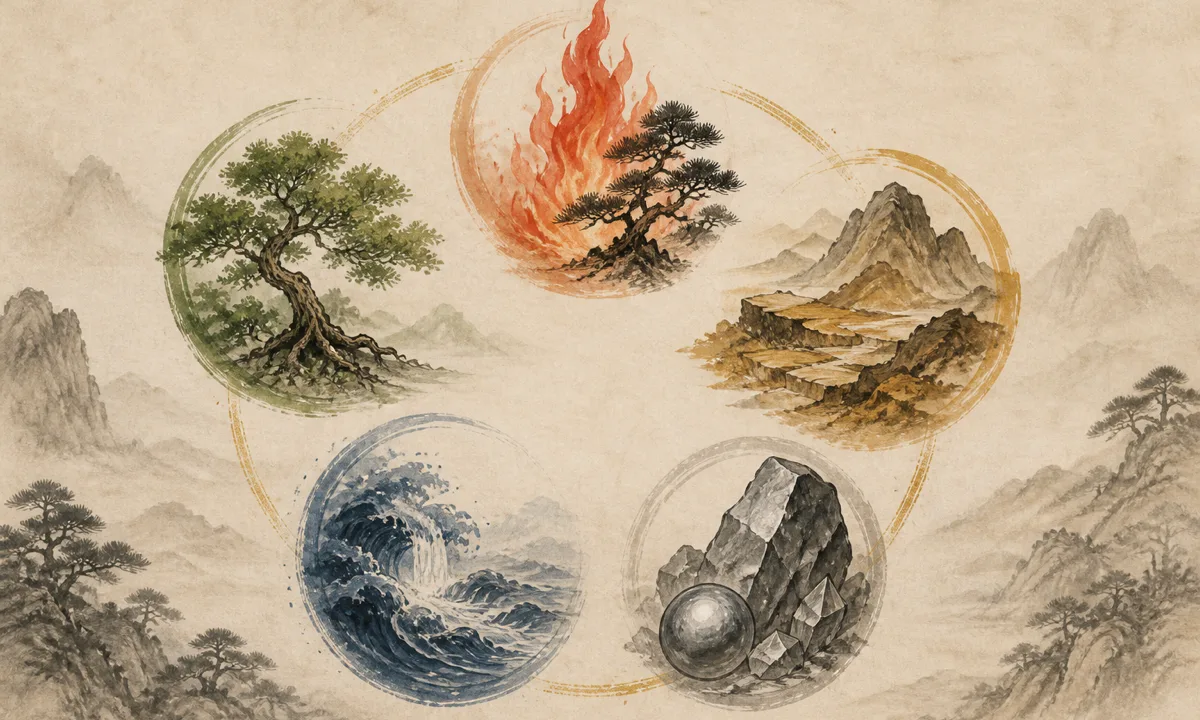
A common Five Elements color chart links Wood with green, Fire with red, Earth with yellow and brown, Metal with white, gray and metallic tones, and Water with black and deep blue. These are cultural correspondences, not universal scientific effects, and associations can vary by school and context.
| Element | Common colors | Related materials or forms | Useful design prompt |
|---|---|---|---|
| Wood | Green, teal | Plants, wood, vertical lines | Where does the space need growth or freshness? |
| Fire | Red, coral, purple | Warm light, points, expressive accents | Where does it need warmth or visibility? |
| Earth | Yellow, ochre, beige, brown | Clay, stone, square forms | Where does it need stability? |
| Metal | White, gray, silver, gold | Metal, circles, clean edges | Where does it need clarity or structure? |
| Water | Black, navy, deep blue | Glass, reflective surfaces, curves | Where does it need calm or flow? |
For a visual reference, QI KIND now treats this page as the color hub: use the chart first, then move to the Five Elements guide, the Five Elements personality quiz, or the shop when you want symbolic jewelry and objects inspired by Wood, Fire, Earth, Metal and Water.
How to use Five Elements colors
In clothing, use an element color as one layer—an accessory, shirt or texture—rather than a rule for your entire wardrobe. In a room, begin with function, daylight, existing materials and the occupants’ needs. Then use color to adjust emphasis: a warm accent for visibility, an earth tone for steadiness, or a deep blue detail for quiet.
The Five Elements guide explains the generating and controlling cycles. The Feng Shui hub places color inside room layout, material and circulation rather than treating it as a standalone cure.
Why “missing element = buy this color” is too simple
A BaZi chart is not a five-item checklist. The Day Master, season, available pillars and relationships among elements matter. A color preference cannot calculate your Day Master, and buying a red, green or blue object cannot guarantee a financial, health, career or relationship outcome.
If you want to see your personal distribution, use the free private BaZi calculator. It calculates the available pillars from confirmed birth information; it does not assign an element from a favorite-color quiz. You can also compare the Five Elements personality test with a chart-based result.
A simple room example
Suppose a home office feels visually cold and scattered. First check lighting, screen glare, chair support, storage and the route through the room. Only then test a restrained palette: warm light or a small Fire accent for visibility, Earth tones for visual stability, and Metal storage for structure. The useful result is a room that works better—not a promise that a color will change fate.
Frequently asked questions
What color represents Wood in the Five Elements?
Green is the most common association, sometimes extending to teal or blue-green. Context and tradition can change the exact palette.
What are the colors of all five elements?
The common set is Wood–green, Fire–red, Earth–yellow or brown, Metal–white or metallic, and Water–black or deep blue.
Can I wear a color to balance my BaZi chart?
You may use color as a personal reminder or cultural styling choice, but it is not a guaranteed correction. Understand the full chart before turning one visible element into a prescription.
Do Five Elements colors replace interior-design advice?
No. Lighting, safety, accessibility, materials, scale and the people using the room come first.