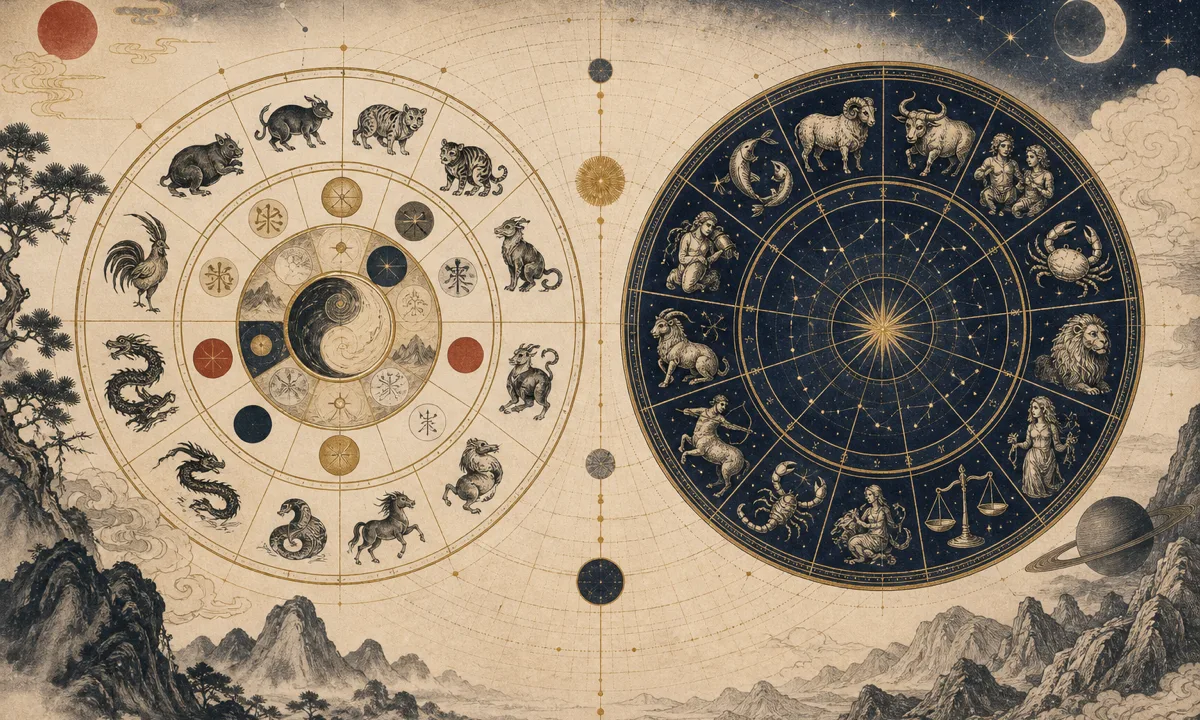
Quick answer: Chinese astrology and Western astrology are two complete systems that answer similar questions with different tools. Western astrology reads the positions of planets at your birth (a circular chart, 12 signs). Chinese astrology reads the time-based energy pattern of your birth (a vertical chart of 4 pillars, 8 characters, Five Elements). Both can be insightful; they are simply two languages for the same curiosity.

---
The 6 key differences
| Western Astrology | Chinese Astrology (BaZi) | |
|---|---|---|
| Core question | "What were the planets doing when I was born?" | "What elemental energy was dominant at my birth moment?" |
| Chart shape | Circular wheel, 12 houses | Four vertical pillars (year/month/day/hour) |
| Main system | 12 zodiac signs + planets | Five Elements (Wood/Fire/Earth/Metal/Water) + 10 Stems / 12 Branches |
| Birth time | Helpful, but sun sign works without it | Required for full depth (hour pillar = 2 of 8 characters) |
| Identity anchor | Sun sign (e.g. "I'm a Leo") | Day Master element (e.g. "my Day Master is Yang Wood") |
| Timing model | Transits, retrogrades, houses | Luck Pillar cycles (10-year phases) + annual outlook |
Why the difference matters in practice
*1. What you get is a blueprint of time, not planets. Western astrology maps the sky; Chinese astrology maps the calendar energy. You can think of BaZi as "what the universe was doing in this moment" rather than "what the universe looked* like."
2. Your identity anchor is an element, not a sign. "I'm a Fire person" (Day Master) works differently from "I'm a Leo" — it describes a balance, not a fixed archetype. This is why Chinese astrology tends to talk about tendencies and rhythms rather than fixed traits.
3. Time precision is non-negotiable for BaZi. Your hour pillar matters — two people born the same day but different hours can have meaningfully different charts. Western sun signs need only your date.
*4. The Five Elements create a relational system.* Elements generate and control each other (Wood feeds Fire; Water controls Fire). Your chart is read as a dynamic balance, not a static list of traits.
Can you use both?
Absolutely — and many people do. Western astrology is often a good entry (everyone knows their sign); Chinese astrology adds depth and timing (what season am I in? when should I move?). They are not rivals; they are complementary lenses. Some users start with Western astrology, get curious about the "why," and find BaZi's structural depth more satisfying for life-timing questions like career moves and relationships.
A note on how to approach either
Neither system is about surrendering control. A chart — Eastern or Western — is a map, not a verdict. It highlights tendencies and timing; you remain the author of your choices.
👉 See what your Chinese chart looks like — free, private, and explained in plain language.
Frequently Asked Questions
Is Chinese astrology the same as Western astrology?
No. Western astrology reads planetary positions at birth; Chinese astrology (BaZi) reads the time-based Five Elements pattern of your birth. Different systems, similar purpose.
Can I use both Chinese and Western astrology?
Yes. Many people use Western astrology as an entry point and BaZi for deeper life-timing questions. They are complementary, not conflicting.
Which is more accurate?
Both are structured systems, not science. Their value is in self-reflection and planning. BaZi offers more precise time-based analysis; Western astrology offers richer symbolic tradition.
What is my Chinese astrology sign?
Your Chinese zodiac animal comes from your birth year, but your full Chinese astrology chart (BaZi) is much deeper — it includes your Day Master element, Five Elements balance and timing cycles.
---
Related reading